Education ∪ Math ∪ Technology

Author: David Wees (page 67 of 98)

Why textbooks should be open source

In the past few years, there has been a push for open source content, and enough resources have been created so that schools can completely do away with the traditional textbook. However, adoption of open source content has been low, and the vast majority of schools are still relying on tradtional textbooks.

Here are some reasons besides "they will cost less" that school districts (and educators) should be pushing for open source content for schools.

  • Reduced cost for transportation if in digital form
    Schools can download the textbook and (if necessary) print it out on campus as they need it, which means they can pay for bandwidth, which most schools already do, instead of paying for shipping.
     
  • Authors paid for hours worked, not for uncertain future sales
    I’m an author of a textbook. It has not seen wide adoption, partially because it is a 1st edition, and partially because the market for the textbook I co-authored is pretty much saturated with a competitors product. I spent many hours writing this textbook, and have worked out that my wage for writing the textbook works out to about $2 an hour. In an open source model, you can release the book once it is published, and just pay the author for the time they’ve worked. Given the enormous savings to school districts after the restrictive license has been removed, this actually makes fiscal sense too.
     
  • Easier to keep updated since anyone can legally make revisions
    Textbooks can be immediately updated as soon as our knowledge of an area increases, or if an error is found in a textbook. Compare this to the speed it takes to update a typical textbook where the only incentive to update the textbook is to increase sales.
     
  • Can be provided easily in any format
    Most textbook are provided in one or two formats, meaning that once you buy a textbook, you are locked to the mode the textbook is available in, whether that is paper, or a pdf. When the textbook has an open source license, it can be legally reformated for any device.
     
  • You can be altruistic and provide curriculum to those who really need it
    There are lots of places in the world which can not afford to create their own resources for their schools. Although there are cultural implications to sending them our Westernized resources, the open source license means they can customize the content for their needs. The creation of open source content is therefore also a charitable activity.
          
  • Pick and choose what you want/remixable
    If the resource doesn’t work for you, you can fix it. You can mix multiple resources, and you can customize the content to whatever your needs are. Try doing that with a traditional textbook. This gives teachers more autonomy over the materials they use.
     
  • Redistribute resources
    Even if you print an open source textbook, the total cost of the textbook is maybe $10. You don’t really care as much what happens to the textbook if it only costs $10. You can take all of the people and resources that were involved in the storing, shipping, and tracking textbooks and use them more efficiently elsewhere.
     
  • Doesn’t need to be just paper
    A digital "textbook" could be so much more than just paper…
     
  • Collaborate between countries
    As someone who doesn’t live in the US, I certainly know how much licensing gets in the way of sharing resources across the border. So often we have to wait ages for resources available elsewhere in the world to become licensed for us in Canada. With an open source license, which much more easily be transfered from one country to another, this access barrier is dropped. Now we can collaborate across cultures and across borders much more easily than ever before. This will also allow for cross-cultural exchange. Imagine being able to download chapters about the American Revolution from the US and UK perspectives.
     
  • Less work for each district
    School districts can share the work for creating content. While some of these resources will be specific to a particular part of the world, much of what we teach in different parts of the world is almost exactly the same. Each school district can therefore do a little bit less work and focus on maintaining their own regional specific content.


Wheel of Fortune Game

My colleague asked me if I could find a Wheel of Fortune game he could use with his 1st grade students. I looked around for a while and found something which sort of worked here. The problem was, the code was kind of broken and needed a lot of repair. However it was the best thing I could find, so I spent a few hours and tidied it up.

You can check out what the Wheel of Fortune game looks like here: https://davidwees.com/php/wheel/

There is a "back-end" where you can add/edit the list of words, but I’m going to keep the location of it secret since my colleague is going to be using the demo version of the game with his class.

If you want to customize it further, you can download my version of the code here (note that you’ll need access to a server which runs PHP and a MYSQL database).


Clayton Christensen on the shortcomings of math education

"The curricular activities are designed to make students feel like failures." Clayton Christensen

When Christensen talks about designing things as an interesting activity for students, I think it’s pretty clear that this is a real world application of mathematics. This problem he talks about, where students have to first learn a bunch of mathematics before doing anything really interesting or powerful with it, is not just confined to the United States. It’s a problem here in Canada too. I’m sure it’s a problem all over the world.

We can design curriculum so that students get to work on really interesting problems. In fact, it’s been done.

(I recommend checking out a series of textbooks published by the Consortium for Mathematics and Its Applications. I’ve looked through the books, and while they won’t replace a good teacher searching for resources, they are a terrific way to start with real problems and look at solving those problems using mathematics.)


The relationship between family income and FSA score

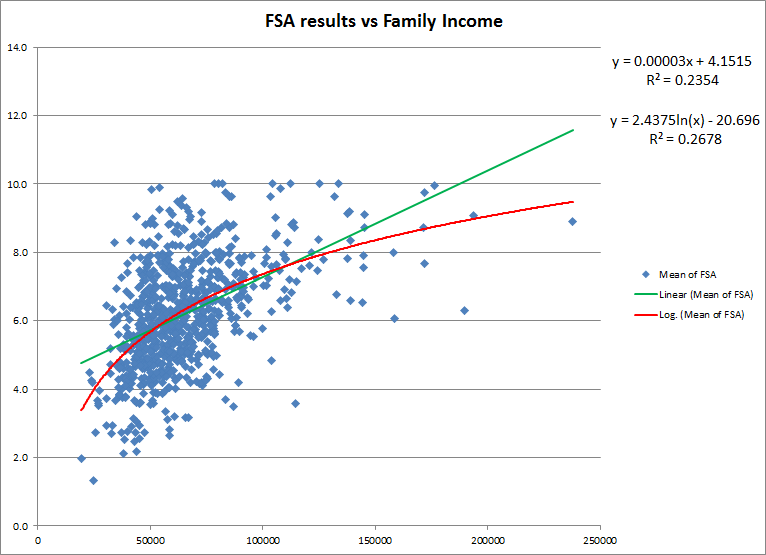
The Fraser Institute released their annual "report" on the Foundation Skills Assessment (FSA, a standardized exam given to 4th and 7th grade students in British Columbia) results. As usual there have been complaints about the validity of the results, and some interesting side stories. I decided to look at the Fraser institute’s results from a particular perspective. I took the FSA data and isolated the "parent income" and available FSA results (out of 10) from the Fraser Institute data. (I could have used the data from the BC government’s education site, but the Fraser Institute data was more convenient to work with.)

After writing a script to scrape the data (download the raw data here) from the PDF provided by the FSA, throwing away schools for which either FSA results or parental income was unknown, I graphed the data.

From the graph it seems clear that there is some sort of relationship between the two variables, but it is not clear how strong the relationship is between family income and FSA scores.

So I’ve calculated a couple of regressions for a linear fit and a logarithmic fit between the two variables. The value of the correlation coefficients are approximately 0.485 and 0.517 respectively (square roots of the r2 values given above), which given the large number of data points is statistically significance, showing that there is a moderate to strong relationship between the mean family income of a school, and the mean FSA scores for a particular school.

This type of analysis has been done before for other standardized tests, most notably the SAT exams in the United States. What this type of analysis shows is that standardized exams like the FSA are better measures of the wealth of a community than the strength of the schools in that community.

The Fraser Institute rankings are a flawed comparison of schools. It is not possible to fairly rank schools of different socio-economic status because of this strong relationship between scores and the family income. What would be more fair would be to re-rank the data and break it down into different sub-classes based on socio-economic status and not try to compare apples and oranges. 

What would be even more fair would be to throw out the exams all together. What we really want to know is how effective our schools are at ensuring that our students are successful. Given the enormous complexity of this issue, and the wide variety of variables involved, finding a solution to that issue will be extremely difficult. A standardized exam is like a fast-food approach to collecting data, it is cheap and fast, but not very filling. 

Blended Learning: The Importance of Face to Face contact

Here’s a great story (shared on the Huffington post) about a student who is attending his school remotely, through a robot. Watch the video below.

The robot has become a proxy for face to face communication, and this family considers face to face communication so important, they are ignoring other, probably easier, solutions for his education. Lyndon could be going to a virtual school and learning remotely through initiatives like the Khan Academy, but he’s not. Instead he and his parents have chosen to send a robot in his stead, which Lyndon controls via his computer. 

In any blended learning model, it’s important to remember stories like Lyndon’s and remember why we would use blended learning over pure e-learning. Although e-learning has the potential to allow for a much greater degree of personalization of learning, it is a poor substitute for face to face interaction. The ability to quickly communicate a lot more than just the course content is a critical aspect of face to face learning. Lyndon has joined this school virtually because he wants the emotional contact with other people his age. He’s not just content "knowing" stuff, he wants to know it through other people’s eyes as well, hence his comment on "the other student’s point of view."

As educators, we do this too. Although we have a thriving community on Twitter, many of us will jump at an opportunity to see each other face to face. We’ll spend collectively spend vast sums of money on going to conferences like Educon and ISTE, or spend hours planning local unconferences. The online interactions are great, but nothing beats a face to face conversation.

Mumbo Jumbo

Algebra is just mumbo jumbo to most people. Seriously.

If you asked 100 high school graduates to explain how algebra works, and why it works, I’d guess that 99% of them couldn’t, not in sufficient detail to show that they really deeply understand it. Remember that I am talking about high school graduates, so these people have almost certainly had many years of algebra and algebraic concepts taught to them. Most of these people will only be able to give you some of the rules of algebra at best, and some of them don’t even remember that much.

Algebra is an amazing tool for solving problems though! Formulate a problem as an equation, and unless the equation is too complex, there is an algebraic algorithm to solve that equation, and hence the problem you formulated.

Maybe it is such a useful tool that people don’t really need to understand how it works, maybe they can get by without a deep understanding, but still be able to follow the rules of algebra and use it to solve problems. I don’t really buy that argument though, simply because people who don’t understand something are prone to make mistakes, and not be able to check their work with a reasonable level of accuracy.

Computers are also mumbo jumbo to most people. If you asked people to explain how computers work, most of them cannot. There are actually very few people in the world who can explain from start to finish how a computer works, and there is no one that can explain every single piece of a computer. Computers are still amazing tools though, and give people the ability to solve problems that would otherwise be intractable.

I think computers are a useful tool despite our lack of understanding of how they work. Like algebra, computers are a block box in which we put our inputs and get outputs and don’t understand how the inputs are related to the outputs. Given this similarity, we should look at other reasons why using a computer might be superior to algebra.

There are some significant differences between using computers to do computation, and using algebra to do computation. The first is that using a computer, the error rate is much lower. Obviously you can still press the wrong buttons, enter the wrong information, read the information the computer gives back to you improperly, so there is error, but I’d argue that this error is much less than the standard error rate for algebra. The second benefit of using computers is that they are much faster than doing even moderately complicated algebra by hand, including entering the computation into the computer. In the case that doing it by hand is faster, then I’d say you should do the calculation by hand. 

The largest difference between using a computer to do the calculation and using algebra is that algebra is a single use tool. It can only be used to turn an equation into a solution. A computer can be used for so much more.

Granted we should consider computational mathematics to be a broader tool than just plain algebra, if we want a more fair comparison with a computer, but I’d argue that all of the same problems exist with other areas of computational mathematics. As we increase the scope of computations we can learn how to use, the power of the computer becomes even more evident. It takes much less effort to learn how to compute a broader scope of problems using a computer than learning all of the individual computational methods. Witness the power of Wolfram Alpha, for example. Enter in a search phrase and all sorts of useful information comes up.

So in the consideration of using computers for solving computations, over a by hand approach, we can see postulate that the computer will produce less errors, be generally faster, and is more multipurpose than the pencil and paper model is. Furthermore, the computers can do a lot more as a tool than what you can do with algebra.

Another issue I see is that our current mathematics curriculums leave very little time to learn more important skills than computation. As Dan Meyer (@ddmeyer) points out, the formulation of a problem is more important than the actual solution. Learn how to formulate problems and understand how to verify that what you are doing makes sense, then spotting errors in computation becomes that much easier. Furthermore, I’d like to see mathematics education be much more grounded in what is relevant, than be a collection of different types of math which are taught for historical purposes or because they are the ground-work for calculus.

The question for me is, why aren’t we using computers more to do mathematics in elementary and secondary education? It can’t just be because people are scared of change, can it?

Understanding nature

My wife and son went to Cathedral grove today. It’s one of the only first growth forests left in BC, and it is amazing. The trees here are spectacular! What I realized when I saw the photos my wife sent me, you cannot understand nature without standing in (literally) her most majestic works.

My son standing inside a tree

I know that for many children who live in highly urban environments, this kind of opportunity is very rare. What can we do to ensure that more children get a chance to actually experience nature in its grandure first hand. Personally, I think that all children should stand inside a tree like this, if only so they can recognize how amazing forests are.

Manufacturing Demand

Thanks to @rmbyrne and his Free Technology for Teachers website, I just saw Annie Lenox’s "The Story of Bottled Water" video which is recommended viewing, but chances are those of you coming to this blog know the story she’s telling already.

In the video, she talks about the process of manufacturing demand, in which a company uses advertising to turn something people don’t need, into something they do. I thought about what she said, and agreed that I myself own many things that I almost certainly do not need. I also thought of the parallel process that is happening in the United States.

Right now educators, parents, and students are being sold a myth of an education system in crisis. By all standards, nothing has changed in education in 40 years across the US, so why is everyone in so much of a panic to change the system? While no one can claim that the US public education system is perfect or isn’t in serious need of improvement, to imply that we should be in a state of panic is at best irrational. When people panic, they will grab at any solution which seems plausible. The US public are being sold a lie, a false-hood, and the solution to the problem all at once.

The US President’s state of the union was fairly uninteresting according to accounts I’ve read because he really said nothing new on education. I didn’t watch it, but he had a pretty simple mesage according to the commentaries I’ve read. "We must do better because we are being beaten. We must do better because the American school children do better." Attached to this message is Race to the Top which encourages charter schools, teacher accountability through standardized testing, and national curriculum standards.

The question you should ask is, if I wanted to change the US education system to be more privatized, how could I convince the US public that this is necessary? Oh right, we’ll just do what we did with the Gulf War, we’ll manufacture a reason why there is a problem, and then provide the solution at the same time, and imply that the only solution lies with greater accountability of teachers.

By implying that teachers are the problem, the US DOE has managed to drive a wedge between teachers and their long time supporters, the parents of the kids they have in their classroom. "Can we trust this teacher," a parent will think, "or are they just trying to save their job?" While fortunately most parents seem to continue to be satisfied with their schools, it is only a matter of time before their (the reformers trying to change the system) message gets through. "American public schools are in trouble and we know the solution."

I don’t see the US system as being entirely in crisis. What I see is a lot of dedicated individuals who are working in a system for a world which needs transformation. I see a lot of educators who like what they do, and would be happy to work differently, but are trapped by the imposed bureacracy around them. I see a system which is failing a lot of students because of its lack of flexibility and inability of US politicians to solve the problem of poverty within their own country.

Instead of the greater accountability movement being pushed on US public education, schools actually need more freedom to pursue an education for children which would actually work. If we think about Zoe Weil, and her work for an education system dedicate toward building a more humane society, we might wonder where that would fit in our current educational model. Could it fit within the greater accountability model? Or would we need to rethink schools completely?

What is it about these people that make them think they can bamboozle the US public so completely? Oh right, because they’ve done it before.

Update: Just so people don’t think I’m making this up, check out this post about how little data these decisins are based on.

15,000 tweets

15000 tweets

I hit a milestone quietly today. I posted my 15,000 tweet. It’s not  a milestone I’m going to celebrate, nor will anyone else, but it got me to thinking. What if we had students with 15,000 tweets?

I’m not talking 15,000 descriptions of their breakfast, or what they are wearing, or any number of fairly inane things, but 15,000 useful links or fragments of conversations with other people. I’m also not talking about retweets, which while useful, are not really me writing anything, but just agreeing with someone else’s statement.

I scanned through 100 of my tweets at one point and realized that I post about 11 words per tweet, not including @replies or #hashtags. So in 15,000 tweets, I’ve posted about 165,000 words, of which maybe a little less than 10% are retweets. I can actually see the impact all of those tweets has had on my writing. I would say that from my first tweets through to my last tweets, my writing has improved; I’ve learned brevity. I’m not saying that everyone of those tweets has been high quality or that 15,000 tweets would be more effective than writing a 150,000 word novel, but they have made an impact on my writing.

If our students took the time I did to sort through information, decide on what’s relevant or interesting, and post it on Twitter, they would become better researchers. If they spent the time in conversations with other people, they would become better communicators and more aware of what’s going on globally. Posting tweets would literally be helping them become informed global citizens.

I read an article that suggested that texting helps improve student’s spelling, and I think Twitter would do the same thing, except it would also help in many other areas. When you send a text message, it goes only to a single person. When you post on Twitter, it goes out to your entire network. The advantage of the network message is that everyone has the potential to give you feedback on what you sent. As a result, your potential feedback is multiplied by many times over text messages. Furthermore, tweets include hyperlinks to other information, and references to other people, and categorization information, all of which are critical aspects of building the semantic web.

There is the argument of course that tweets are shallow pieces of information, but what I have noticed is that as people tweet, sooner or later they realize they will need a blog to act as a container for their longer thoughts. It is difficult to convey a complicated message via Twitter, but you can link to your thoughts expanded and collected in full on a blog fairly easily. So I see blogging as complementary to tweeting, and I think you can easily argue that blogging should help students similarly see improvements in their writing. It’s another form of public reflection, and another way of getting feedback on what you are doing.

So I say, when people ask you if students should tweet away, I say let them. They just might write a novel or two.