This isn’t using technology effectively. If someone thinks this is the school of the future, and the school I send my son to decides to do this? I’d quit my job so I can homeschool him myself.
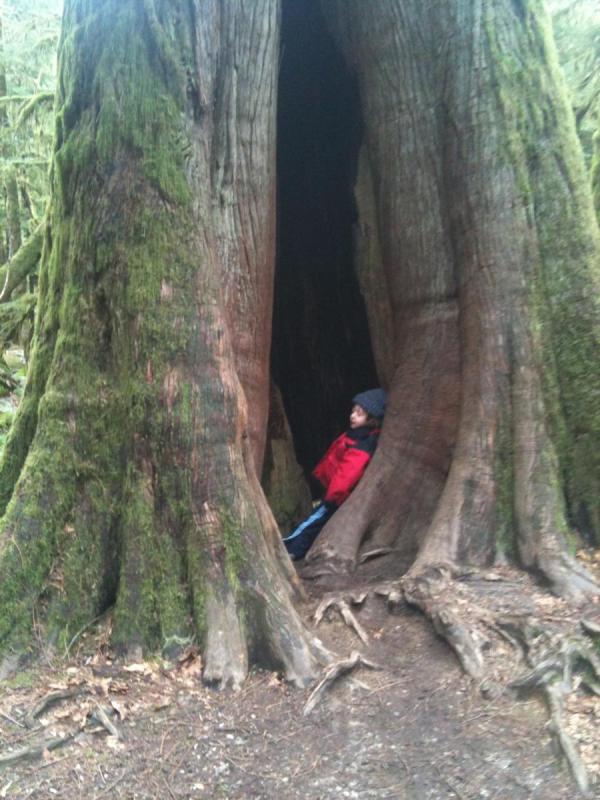
My wife and son went to Cathedral grove today. It’s one of the only first growth forests left in BC, and it is amazing. The trees here are spectacular! What I realized when I saw the photos my wife sent me, you cannot understand nature without standing in (literally) her most majestic works.
I know that for many children who live in highly urban environments, this kind of opportunity is very rare. What can we do to ensure that more children get a chance to actually experience nature in its grandure first hand. Personally, I think that all children should stand inside a tree like this, if only so they can recognize how amazing forests are.
Thanks to @rmbyrne and his Free Technology for Teachers website, I just saw Annie Lenox’s "The Story of Bottled Water" video which is recommended viewing, but chances are those of you coming to this blog know the story she’s telling already.
In the video, she talks about the process of manufacturing demand, in which a company uses advertising to turn something people don’t need, into something they do. I thought about what she said, and agreed that I myself own many things that I almost certainly do not need. I also thought of the parallel process that is happening in the United States.
Right now educators, parents, and students are being sold a myth of an education system in crisis. By all standards, nothing has changed in education in 40 years across the US, so why is everyone in so much of a panic to change the system? While no one can claim that the US public education system is perfect or isn’t in serious need of improvement, to imply that we should be in a state of panic is at best irrational. When people panic, they will grab at any solution which seems plausible. The US public are being sold a lie, a false-hood, and the solution to the problem all at once.
The US President’s state of the union was fairly uninteresting according to accounts I’ve read because he really said nothing new on education. I didn’t watch it, but he had a pretty simple mesage according to the commentaries I’ve read. "We must do better because we are being beaten. We must do better because the American school children do better." Attached to this message is Race to the Top which encourages charter schools, teacher accountability through standardized testing, and national curriculum standards.
The question you should ask is, if I wanted to change the US education system to be more privatized, how could I convince the US public that this is necessary? Oh right, we’ll just do what we did with the Gulf War, we’ll manufacture a reason why there is a problem, and then provide the solution at the same time, and imply that the only solution lies with greater accountability of teachers.
By implying that teachers are the problem, the US DOE has managed to drive a wedge between teachers and their long time supporters, the parents of the kids they have in their classroom. "Can we trust this teacher," a parent will think, "or are they just trying to save their job?" While fortunately most parents seem to continue to be satisfied with their schools, it is only a matter of time before their (the reformers trying to change the system) message gets through. "American public schools are in trouble and we know the solution."
I don’t see the US system as being entirely in crisis. What I see is a lot of dedicated individuals who are working in a system for a world which needs transformation. I see a lot of educators who like what they do, and would be happy to work differently, but are trapped by the imposed bureacracy around them. I see a system which is failing a lot of students because of its lack of flexibility and inability of US politicians to solve the problem of poverty within their own country.
Instead of the greater accountability movement being pushed on US public education, schools actually need more freedom to pursue an education for children which would actually work. If we think about Zoe Weil, and her work for an education system dedicate toward building a more humane society, we might wonder where that would fit in our current educational model. Could it fit within the greater accountability model? Or would we need to rethink schools completely?
What is it about these people that make them think they can bamboozle the US public so completely? Oh right, because they’ve done it before.
Update: Just so people don’t think I’m making this up, check out this post about how little data these decisins are based on.
I hit a milestone quietly today. I posted my 15,000 tweet. It’s not a milestone I’m going to celebrate, nor will anyone else, but it got me to thinking. What if we had students with 15,000 tweets?
I’m not talking 15,000 descriptions of their breakfast, or what they are wearing, or any number of fairly inane things, but 15,000 useful links or fragments of conversations with other people. I’m also not talking about retweets, which while useful, are not really me writing anything, but just agreeing with someone else’s statement.
I scanned through 100 of my tweets at one point and realized that I post about 11 words per tweet, not including @replies or #hashtags. So in 15,000 tweets, I’ve posted about 165,000 words, of which maybe a little less than 10% are retweets. I can actually see the impact all of those tweets has had on my writing. I would say that from my first tweets through to my last tweets, my writing has improved; I’ve learned brevity. I’m not saying that everyone of those tweets has been high quality or that 15,000 tweets would be more effective than writing a 150,000 word novel, but they have made an impact on my writing.
If our students took the time I did to sort through information, decide on what’s relevant or interesting, and post it on Twitter, they would become better researchers. If they spent the time in conversations with other people, they would become better communicators and more aware of what’s going on globally. Posting tweets would literally be helping them become informed global citizens.
I read an article that suggested that texting helps improve student’s spelling, and I think Twitter would do the same thing, except it would also help in many other areas. When you send a text message, it goes only to a single person. When you post on Twitter, it goes out to your entire network. The advantage of the network message is that everyone has the potential to give you feedback on what you sent. As a result, your potential feedback is multiplied by many times over text messages. Furthermore, tweets include hyperlinks to other information, and references to other people, and categorization information, all of which are critical aspects of building the semantic web.
There is the argument of course that tweets are shallow pieces of information, but what I have noticed is that as people tweet, sooner or later they realize they will need a blog to act as a container for their longer thoughts. It is difficult to convey a complicated message via Twitter, but you can link to your thoughts expanded and collected in full on a blog fairly easily. So I see blogging as complementary to tweeting, and I think you can easily argue that blogging should help students similarly see improvements in their writing. It’s another form of public reflection, and another way of getting feedback on what you are doing.
So I say, when people ask you if students should tweet away, I say let them. They just might write a novel or two.
So today I returned a laptop that a student had forgotten at school to a student during our homeroom. Two of his friends were standing nearby and expressed their shock that he would be so careless with his laptop.
Student 1: "How could you be so careless with your laptop? It’s a crucial part of our learning!"
Student 2: "It’s our main tool for school!"
The students obviously recognize the value of the laptops for their education. Why don’t more educators?
I had an idea tonight for a project that would be cool if we could implement it. The basic idea is, we submit complete information about a bunch of schools which are known to work, and then we break those schools down into their component pieces, such as assessment policy or their science curriculum. We then provide an interface so that people can remix these schools.
I think of schools as being driven largely by policy. Yes, individual teachers make a difference but those teachers are generally hired to a school because of a policy about how teachers are hired. By and large the decisions about how schools are run, and how successful they are (with the given population of students they have) are made at the policy level, rather than the day to day action of the teachers. Think of the cumulative action of the teachers as making a difference, but that cumulative action is driven by your assessment policy, your classroom discipline policy, and so on. Even a purely democratic schools, in which every major decision is decided by the democratic process has an over-arching policy, they’ve chosen to be a democratic school.
So imagine we have all of the policies for a bunch of successful schools, and we were able to remix them. We would be able to to pick and choose between the policies (where they are compatible) and develop our own school models. Schools might be able to re-examine their own policies more critically and make some changes to improve their own model. The very nature of what makes an individual school successful would become shared public knowledge.
I’ve been reading about people trying to implement a paperless classroom, and it occurred to me that there are plenty of things you can do to implement this type of classroom, without using a lot of technology. You don’t need a 1 to 1 laptop program at your school to make it a (nearly) paperless classroom.
First buy some whiteboard material from your local carpentry supply store. Cut it up and make pieces about two feet (60 cm) by three feet (90 cm) in size.
Here is an example of a classroom run using these whiteboards.
Having some larger whiteboards on which to share instructions or information is useful. Instead of handing out sheets of paper to students, most of what you will share will go on these whiteboards. I used to write down instructions for a project, or practice questions, or discussion ideas up on a whiteboard before school and when the particular class came in, I would put out the appropriate whiteboard. Doing this will eliminate the worlksheets from your classroom.
Next, find 3 or 4 desk-top computers to place somewhere in the back or side of your classroom, or even better separate them around the classroom so that students can crowd around them when necessary. These are your research stations and the places where students will create permanent digital copies of their work. An organization like Free Geek can help you reduce the cost of purchasing these, or you may even be able to find corporation to make a donation. It is important that at least one of these computers is reasonably decent and has an Internet connection, but the other ones don’t have to be awesome. It is amazing how much utility you can get out of an old computer when it’s running a low memory operating system like Ubuntu.
Having a document camera, or a projector hooked up to the one of the computers in the room would be useful, but not critical. You can see from the picture above that the whiteboards are large enough that when students are sharing their work, they can just hold up the whiteboard and let everyone see it. Alternatively you can treat the sharing of work as a mini-fair where each group takes a turn looking at a few other group’s work.
It would also be a good idea to equip this classroom with at least 1 or 2 digital cameras. These can be useful to take pictures of the work the students have done on the whiteboards. You can designate one of the computers as your media storage computer and upload the pictures to this computer since you will want some record of the student’s work for later.
You will also need some notebooks for the students to record other work, particularly in writing-rich classes. In some subjects you may find that the notebooks don’t see enough use to be needed, but in others they will fill up quickly. This is where most of the paper you will use in your class will be. The notebooks will be the place where individual reflection will take place and can either be shared or not shared, depending on your preference.
Another piece of the puzzle will be a library of books on the back wall, relevant to your subject area. This way students can do “off-line” research. Yes, some of the books will be woefully out of date, but if you have a variety of books, you can help kids understand that they need to examine multiple sources, and not just accept the first thoughts on a subject they find.
Most of the work students will do will happen on the whiteboards and will disappear forever after it has been erased from the boards. Some of it will be saved on the computers as a picture taken of the whiteboard. Some of it will be transcribed to the computers as you and the students decide on what summative assessments you will include.
The type of work students will do will be collaborative. Most of your assessment will be formative as you move around the room to ensure both that the students are on task, but also that they are meeting your shared expectations. Your summative assessments will either be recorded in the notebooks, or on the computers. You can use workstations as a way to differentiate your work, and to ensure that not everyone “needs” the computers at the same time.
The (nearly) paperless classroom starts with the assumption that not every piece of work students produce is worth saving forever. Most of it is just them sharing their thoughts. Think of the notebooks and workbooks your students currently have, and the notes that they take. 99% of that work will never be looked again once it is completed. It is only as small percentage of work that needs to be immortalized on paper.
Change your mindset that the paperless classroom needs a lot of technology. It doesn’t. It needs a transformation of pedagogy from teacher centred and content focused to student centred and a focus on developing skills.
Please share any other ideas you have on implementing the (nearly) paperless classroom.
I tell a lot of stories when I teach, but not generally stories about my life or past stories of students. I use story-telling as a vehicle for explaining concepts that are difficult to understand when abstracted in symbols.
Supposedly when Gauss was a kid, he was given the task of adding up the numbers from 1 to 100. His teacher expected this task to take a while, but Gauss finished it in seconds. He apparently was the only student to write down the correct response, 5050. What Gauss did was to group the additions from 1 to 100 like so:
1 + 100
2 + 99
3 + 98
…
50 + 51
He noticed that each of these added up to 101, and that there are 50 such pairs. 50 x 101 = 5050, the answer Gauss came up with.
When I share this story with students, they tend to remember the process Gauss went through and they identify with him, not because he’s so smart, but because he bests his teacher which is a story a lot of students would like to believe. They remember the story because our minds are adapted for remembering stories.
Leading students through the more abstract proof of the sum of an arithmetic sequence formula is a lot easier when they understand where it comes from. I find story-telling in mathematics is an easy way to turn an abstract concept into something kids get and in my experience practically everything in mathematics comes from a story.
Want to explain infinite series? Tell the story of Achilles and the Tortoise. Want students to understand distance vs time graphs? Make sure to tell a story as you trace out the graph, particularly one with a lot of action you can pantomine.
Update: Here’s an example of a story being told in video form.
Multimedia can make telling the story easier, especially if the concept you want to share is complicated. Think of the pictures that you see in children’s books, and ask yourself, how much do they contribute to the telling of the story?
Story-telling is an excellent tool in mathematics education. How could you see this used in your own subject area?
So I was responding to comment on this blog about student retention, and the person used the word "level" and it made me think of "leveling up" which is this process by which your fantasy character becomes more powerful as a result of the experience they gained. This video below describes the process of leveling up in World of Warcraft (an online fantasy role-playing game). I also remember reading about a professor who was planning on giving experience points for assignments rather than grades.
The thought I had here is, grades on assessments are the "experience points" our students gain, and their school grade (K to 12 in the US & Canadian systems) is their "level." Experience points become a measure of how much your fantasy characters have learned over time, and when you have learned enough, your character gets promoted. As your fantasy character gains levels, they gain abilities, much in the same way students gain skills & mastery of content.
I think this simplistic view of how school works is wrong for a couple of reasons. First, many assessment students do, particularly under assessment of learning systems (as opposed to assessment for learning) are not learning activities, so the idea of applying experience points breaks down here. They simply aren’t gaining experience from the activities in a nice smooth linear fashion. The second reason is that what students are capable of doing does not come in nice neat quanta as suggested by the metaphor of levels. Instead students are complex organisms which grow and develop over time. There may be times when they make leaps and bounds, but really their development comes in small incremental changes, rather than suddenly gaining new capabilities.
So if you buy my argument from my previous paragraph, now our concept of traditional grade levels becomes a bit questionable. We treat students like they are capable of more in 8th grade than they were in 7th grade. How many times have you heard yourself saying "now you are in 12th grade, you shouldn’t act like that!" Our current school system makes hardly any allowances for students who are at different points along the learning continuum. Instead we treat students almost exactly like my analogy.
Retaining students, or complaining of social promotion are just symptoms of a larger problem. We need to stop grouping students by their perceived "experience point level" and start grouping them by what they skills they have mastered.
We had a silly ceremony when I was in first grade. It was called "the first grade graduation ceremony." We all stood around and our families all came out and we celebrated our graduation from first grade. We were even given little certificates to hold onto to remind us of the experience. I have no idea if my mom still has mine, but I doubt it.
We stood in line and each name, except one, was called. I still remember the look on my friend’s face when his name wasn’t called. When they should have called his name, he twitched a little, like he was expecting to be called. His face changed and a look I had never seen before on another person’s face came over him. That look on his face told me that he understood what had happened and felt a deep sense of shame he didn’t know how to handle. I didn’t know what it meant then, but later in life, I learned it well (but that’s another story).
When I think of that moment, I have a weird discomfort that follows and I remember thinking at the time, why isn’t he graduating? My friend wasn’t graduating because he’d been retained. He’d been held back another year. He had attempted first grade, and been found wanting.
The fact that I still remember this moment, from nearly 30 years ago so vividly should tell you something. The moments that we think kids will get over and forget about are actually the ones that kids remember most. If it would be a painful memorable experience for an adult, it’s a painful memorable experience for a kid. We can’t absolve ourselves of guilt simply by thinking that we aren’t doing permenant harm to these children. We are.
The research on retention, as I understand it, is quite clear. "[T]he cumulative evidence does not support the use of grade retention as an intervention for academic achievement."
If grade retention is so bad, why are schools still doing it? Doesn’t anyone read education research before they enact these kinds of policies in schools?