Education ∪ Math ∪ Technology

Author: David Wees (page 69 of 98)

All I have are questions

I might post on this blog like I know what I’m talking about but each of these posts is a question really, an internal discussion that I share. I’m finding I have more questions than answers now.

The current model of education doesn’t work in my opinion, but I can’t see what should replace it.

The best models don’t look like they are very scalable, and would be difficult for the general public to even understand. The recent uproar in the Canadian media over the simple idea that we should value every child has certainly taught me that we need to do a lot of work educating the public about what we do.

I like using technology in my teaching. It lets me do things and have my students construct meaning in ways that I never could have managed even a few years ago. I am worried however that generalizing what a few teachers do really well can be really damaging when diluted to the general teaching population. Introducing computers in most teachers classrooms leads to mass distraction in my opinion, especially given the lack of training that teachers have with them.

Formative assessment is good for example, and the best educators recognize that we should be assessing our students understanding informally all the time. Some schools have turned this into "thou shalt test and grade thy kids insessantly until their fingers bleed where they grasp their #2 HB pencils," and really damaging students. Using technology ineffectively can similarly turn into a gong show.

Worse, applying this use of technology to every school is incredibly expensive. There are 76.6 million people in some sort of school in the United States alone, if each of these people had a $500 laptop, that would cost the US about $40,000,000,000 to outfit each student, not including the cost of distribution, maintenance, and software which could potentially triple those costs. By comparison this article suggests that to end world hunger, it would cost $195 billion. Given a choice between using my fancy tools with my students, which I LOVE to do, and ending world hunger, even for a year, I’m going to choose the latter. Obviously it’s not that simple, but it gets you thinking, is it worth it?

I’ve read that people think that students should be taking online courses, or moving at their own pace through videos, but this model worries me. I’m worried because I’m beginning to feel more and more that the important parts of education happen between the lines of the curriculum. If students spend more of their time learning in physical isolation from each other, these moments will begin to disappear.

I’m also worried that this will become another way to fleece the public pocket as educational publishing companies move toward a rental model of content and that educators as a whole are not yet ready to embrace the open source movement. We might get locked into a proprietary model before the open content model has gained enough of a foothold. Why is this important? Given the deep philosophical divisions in our society, do you want someone else having even more control over what your children learn? It is a lot easier to delete an "inconvenient" moment in history when all of your information is in digital form. I’m not being paranoid, revisions to history happen all the time in public school textbooks.

Some have suggested that we need to refine the accountability model for education. If we just test the students more carefully, and then use this data to change how we hold teachers accountability, that this will drive educational improvement. Of course this model conveniently forgets the narrative that we’ve been testing our students more and more for the past 20 years and seeing a steady decrease in school quality at the same time. It also forgets that there is an extremely strong relationship between student test scores and their poverty level. Poverty is a result of poor education, is their claim, rather than an effect of a decrease in real earnings, or a widening gap between the rich and the disappearing middle class. The only benefit I can see, as these so called reformers spout their nonsense, is that they have helped crystalize my opposition to the use of standardized tests for high stakes purposes. How did these educators, and many of them are educators although some are not, get so far off track from student learning?

I also wonder about alternative education. I’ve been reading about homeschooling, unschooling, Montessori schools, Waldorf schools, and all sorts of interesting ways to educate people. I’ve read some of John Gatto’s work recently and beginning to wonder if I haven’t done a great deal of evil over the course of my career unwittingly. "Think like I do" I say, and help erode my student’s ability to think independently. How do I balance an obvious need of society for some structure with my belief that everyone needs to be capable of independent reasoning? Gatto has some strong arguments exposing some serious flaws with public schooling and reading them makes me feel uncomfortable.

A year from now I may look at what I’ve written here and think I’m being pretty foolish. Right now though I feel like I have a million questions and not enough time to answer all of them. 
 

You need to give them the tools

Container of coins

Every elementary school classroom should have about $20 in change. Not fake money printed on a piece of paper, but real money. Yes, some of it will go missing over time, and you might need to lock it up depending on your community, but honestly it’s worth the risk. It’s only $20.

Like it or hate it, money is an integral part of our lives. If you want your students to understand the world, you have to provide them with the tools they need. Your students aren’t going to learn about how to add up change without holding it in their hands.

What is the International Baccalaureate?

I read an article on the Principal’s blog by Mel Riddile talking about the changes the AP is implementing and how these changes will make it more like the International Baccalaureate (IB) program. He asks a teacher who has been fortunate enough to teach both programs for a long time. Her response kind of irked me because she focused almost entirely on what I consider to be the logistical set-up of the IB as compared to the AP, rather than the major philosophical differences, which at least Mel touched upon.

She said:

"The IB requires laboratory work but the instructor can choose which labs will be performed and they must be at least partially developed by the student."

I left a comment on his blog that the IB was about so much more than just a few labs.

There is more of a philosophical difference between the IB and AP as well which Sherry seems to miss. The IB is not about the courses or the content, it is primarily about their mission statement.

"The International Baccalaureate aims to develop inquiring, knowledgeable and caring young people who help to create a better and more peaceful world through intercultural understanding and respect.

To this end the organization works with schools, governments and international organizations to develop challenging programmes of international education and rigorous assessment.

These programmes encourage students across the world to become active, compassionate and lifelong learners who understand that other people, with their differences, can also be right." (from their website: http://ibo.org/mission/)

The IB is about developing a whole student. You can’t just take an individual course and consider yourself an IB student, it doesn’t work like that. Teachers have to frame the curriculum from the perspective of the 10 learner profile traits of the IB (see http://www.ibo.org/programmes/profile/ and watch the video).

Students also do a self-directed course as part of the IB where they all write an academic essay of about 4000 words on almost any topic they choose. They have to show a commitment to learning outside of school in the form of the CAS program.

The IB program is about so much more than just some instructor choice in what labs students do.

Almost all of Sherry’s explanation of the differences between the AP and the IB is about the ways courses are structured and what information was given to instructors in order to prepare them for teaching the course. Only one sentence in mind spoke out to the really big difference between the two programs.

"Obviously, the benefits to the students working in this kind of laboratory situation where problem solving was critical transformed lab days for me and my students."

So the IB is about critical thinking but also about a host other important skills. It is a complete program, not a small part of a larger high school curriculum. A much wider range of students will be successful in the IB program than a full complement of AP courses. The IB is not just the AP dressed in different clothing or wearing a different skin.

It’s The Skills

So a student of mine just mentioned me in this tweet.

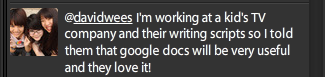
Teaching ppl how to use google docs. Never thot Id be using it after high school. Thankyou mr. davidwees

So the background to this story is that this is a student of mine, and that I taught her IB Mathematical Studies and Calculus in school a couple of years ago. The calculus class was taught using much lecture (unfortunately) but had this huge project we worked on about trying to figure out if a mission to Mars would be possible, using some calculus to help answer the question. One of the tools that I taught them how to use as part of this project was Google Docs.

Apparently she is working in a children’s television and thought that they might find using Google Docs useful for writing scripts.

davidwees I'm working at a kids TV company and their writing scripts so I told them that google docs will be very useful and they love it!

So she’s actually using something she learned in my class and applying it to her work. Very cool. Notice though that it’s not the calculus that she’s applying, or the ability to sit in a lecture and listen quietly. Nope. It’s one of the technology skills that I taught her that she is finding useful.

So I decided to ask her if she had used any of the mathematics I taught her. I actually had this student for two courses and one of those courses was an applied mathematics course so you’d think that there might be some chance she’d used some of it. Here’s her response.

davidwees um no, sorry :(

This is just more anecdotal evidence for me that the most important things we teach in our classes don’t lie between the pages of the textbooks we use. It’s the skills, not the content.

Reward Innovators with Responsibility

A problem with education is that we have too many "best practices" and not enough innovation. Once you establish a procedure as a best practice there’s no room for argument about whether or not it works. We should call it a "current practice" instead. Now we have the freedom to explore this practice and confirm whether or not it is actually working, and find new innovations in education.

We need to encourage more innovation in education and explore a wider range of what is possible. People need to be rewarded for their innovation by being given the responsibility to implement it, provided that they can show solid evidence that it works for other educators too. We need more peer review of what we do as educators.

Imagine a teacher has an idea for improvement in their teaching. They try it in their classroom, bounce the idea off of a friend and collect evidence that it works. They convince a colleague to do the same, and show that whatever it they are doing differently works for both teachers. They submit their idea to a peer review panel, which then would make recommendations on what ideas have wider merit. The teacher who had the original idea would then be given the responsibility and the authority to try out their idea with a wider group of students or teachers. Teachers would be rewarded for innovation with the responsibility to see their idea through, and spreading it to other schools where it could also work.

We would end up with a lot of benefits from this system. First, the amount of collaboration between educators would increase. Next, school improvement ideas would spread out of the school in which they are initially implemented. There would be encouragement to share one’s ideas rather than jealously guard them. Furthermore, educators would be encouraged to innovate. It would lead to improvements in education by greatly increasing the pool of talent to produce possible innovations. So many educators come up with awesome ideas that never make it past the door of their classroom.

Let’s turn our system which just uses "best practices" as determined into researchers into one which includes innovations from educators in the field.

Computers should transform mathematics education

Stephen Shankland posted an interesting article on CNET today. Here is an exerpt from his article, which you should read in full. He says:

Clearly, children need some understanding on their own of math, and reliance on a computer has a lot of drawbacks. But computers can also aid those who otherwise would fall by the mathematical wayside, or let people with more advanced abilities bypass drudgery and move on to the challenging material. Graphing calculators can let many students explore curves and functions that realistically they’d more likely ignore if they had to plot them by hand.

My response to some of the negative comments about his article is:

Some of you have decided that using technology to handle calculations in mathematics is going to weaken student’s understanding of mathematics. I have to tell you, our student’s understanding of mathematics, and even the vast majority of people’s understanding of what mathematics is pretty bad. Awful. Horrible. I mean, really, really bad.

Mathematics is not about calculations. Mathematics is about understanding how our world works through the lens of logical reasoning and pattern forming, and then communicating our understanding of that process to other people.

Calculations are a tool in mathematics to understand a process. In my opinion, I want students to understand the processes and ideas that mathematics represents, not the calculations which short-cut that understanding.

Here’s an example that Gary Stager suggested to highlight this problem. Ask a typical math teacher to explain to you why "you invert the 2nd fraction and multiply instead" when dividing two fractions works. Ask them to explain the concept behind "inverting and multiplying" two fractions, and you know what, they can’t. They’ve learned a recipe for doing a calculation but have no conceptual understanding of why that rule works, and these are people who are teaching our children about mathematics!

We need to move away from the mindset that the most important part of the mathematics curriculum we teach is the rote calculations which can generally be done much faster on a computer, and towards the mindset that students need to be able to formulate problems, decide on appropriate mathematics to use to solve these problems, and then do the calculations on an appropriate device, and finally check that these solutions make sense. These are the steps that Conrad Wolfram and Dan Meyer (in their TED talks) outline as crucial to mathematical understanding, and I completely agree.

Mathematics education needs to change. Those people who want a "back to basics" approach and get rid of the calculators seem to think that this will improve the mathematics education in our schools. This is flatly not true.

If you ask a random sample of people, they either "weren’t very good at mathematics" and generally hated it, or a very small minority loved it. This opinion spans all age groups and goes back many years, far before the introduction of calculators in schools. If we judge the success of an educational approach by the number of people who enjoy working in a subject, why are so many people who were exposed to that approach before the introduction of calculators hate mathematics so much?

Maybe we need to rethink our approach?

What works in education

Let’s suppose the picture below represents the possible states schools can be in, with the peaks being "good" places to be and the valleys being bad places to be. We don’t really know yet what variables we are even representing with this picture, in fact it is likely that the picture itself would be better represented in 20 or 30 dimensions, as there a huge number of factors which affect how successful schools are.

Peaks and valleys

(For those of you who are interested, the equation of this curve is z(x, y) = sin(3x) + cos(2y) + 1.5sin(x) – 3sin(0.5y) and it was created using GraphCalc)

The first thing which is clear from this picture is that there are a lot of ways to be a good school. No one formula works, no single arrangement of the variables corresponds to the best solution. Similarly there are a unfortunately lot of ways to be a bad school. 

The next thing I notice about this picture is that it’s not easy to be at the top of one of these peaks. Make a small nudge in policy, lose a key teacher or administrator at your school, and you can quickly move from a peak to a valley, and your students suffer. The valleys are hard to move out of because of the inertia of a bad school and the energy required to overcome that inertia. Educators can literally feel like Sisyphus, pushing their school out of a valley only to see it collapse back down again with a change in district support, funding, or policy.

Worse, this picture changes over time and the peaks and valleys don’t remain in the same places as external pressures push on schools. Outside pressures from society can have huge influences on school. Think about what schools would look like if the Internet had never been invented. Would they need to change that much? What about if the civil rights movement hadn’t happened?

It is also equally possible that two people from different schools could be standing on different peaks and not recognize that each person works in a wholely different but equally successful school. Or that two people could be in different valleys, and what works to improve one school is completely unsuccessful at another school.

The key message here is that there is no one single formula to improve a school. All standardizing curriculum and increasing accountability in schools will do is shift schools in the same direction on this graph. This will work for some schools, and fair at others, and can potentially push successful schools out of a peak.


Triangles Are Your Friends

I got owned by one of my students today in math class which doesn’t happen terribly often to me. Here’s the situation, see if you can tell whose solution is really a better way to approach this problem.

Picture of my whiteboard from class

My student, instead of approaching this problem from my algebraic method using the distance formula drew some triangles and using the Pythagorean theorem to solve the problem. Her solution was much easier to understand and easier to work out. No one even completed the problem the way I was suggesting to do it. So I got owned.

You can’t discover these kinds of interesting solutions to problems if you require rigid step-by-step solutions. I got some professional development today and some advice from my 16 year student. She said, "Triangles are your friends." I gotta say, I agree with her.

Arbitrary Deadlines

I read this article by Alan Stange on assigning penalties to students who hand in work late. He makes the point at the end of his blog post, "There is in fact relatively little significance to learning to complete on time." I agree with this statement and I’m going to expand upon it.

Who set the deadline for the assignment? Why was that particular deadline set? In most cases I am sure the answer to the first question is the teacher, and the answer to the second question was that because that particular deadline was convenient for the teacher. Some schools have got better answers to the 2nd question in the form of homework and assignment calendars, and if your school isn’t already doing some sort of load-balancing of assignments on students, I recommend it as a good starting place. 

When the teacher assigns the deadline for the students, they are sending a message. "I am your boss, you will do as I say," which reinforces the teacher student hierarchy. If the teacher explains the reasons for a particular deadline, the hierarchy still exists, but now the teacher has become the "supportive" boss. If a teacher is willing to extend a deadline for a student, they are now the "empathetic" boss. However, they are still the boss. Do we want to tell students that what is important in your classroom is who is in charge?

Deadlines teachers assign are largely arbirtrary. In some cases they are meant to be logically placed around holidays, end of semesters, or between other teacher’s assignments, but these are arbitrary placements. If a deadline is arbitrary, why are we so stuck as teachers on making sure students meet it? What outcome are we hoping for from students when we are in charge of the deadlines?

If you listen to some educators, they’ll tell you that meeting deadlines teaches responsibility, and that meeting deadlines gives you a sense of purpose. So we might assign deadlines for these two reasons, if either of them was true. As far as I know, there is no research to support either of these claims.

Tell me the last time you met a deadline for a major project, say a curriculum review. Did you feel like had a sense of purpose? Did you feel like it taught you responsibility? It’s not the meeting of the deadline that gave you your sense of accomplishment, it was the completing of the project. Completing things makes us feel good. We feel proud of ourselves when we produce something awesome. It doesn’t matter in most cases if it took us 2 days or 20 weeks (unless you are trying for a speed record), we feel good because we finished.

Furthermore, who can really say that a project is really done? Even a published book has errors, and ends up being republished with revisions. Nothing is really ever done, we just decide we are done working on it when we feel like it is a "finished" project. I’ll probably come back and read this blog post in a year and find things I want to change.

So here’s my challenge to you. If you really feel you must have deadlines for assignments, find reasons why the deadline matters. Make the deadline less arbitrary. For example, "we need to finish these projects by Friday because the Mayor of the city is going to come and see them then" or "We have to have the letters done soon because our friends in Kenya are expecting them." 

Alternatively, take the time to discuss the deadlines with the students. Ask them what they think and what would work for them. Remember, to you the deadline is mostly arbitrary, letting the students decide on the deadline won’t make it any less arbitrary, but it will give them some choice. 

Our schools are currently intended to produce worker bees, and drones, but not thinkers. Our insistence on enforcing arbitrary deadlines just reinforces the power relationship between students and teachers and prevents students from being able to make their own deadlines and become more self-directed in their learning.

A merit-based pay system for BC teachers?

Sandy Hirtz of CEET BC asked this question over at the CEET BC Ning.

"British Columbia Liberal leadership hopeful Kevin Falcon says public school teachers should be paid according to their teaching skills, not their length of service or level of professional training. He thinks a merit-based pay system should be implemented. What do you think?"

Here is my response.

When we think of merit pay, it is an attempt to turn the skills teachers have into a commodity. This works for some other professions because it is easier to attach financial value to what people do.

If you work in a profession where your work has a measurable financial impact, you can determine which of your employees has had the greatest financial impact by looking at various factors, including total sales in a marketing or sales profession, number of cases won and settled in law, etc… So it makes more sense to reward your employees for the good work they’ve put in. If you follow the research Daniel Pink has collected though, you’ll find those rewards don’t help the people in those professions work better, in some cases it actually hinders their profession.

Whether or not merit pay will improve teacher [performance] is a moot question however since there are no obvious financial gains from a teacher who performs well, or at least no gains that one can see in any useful time frame. If we buy the argument that people who are better educated make more money, and that a good teacher leads to better educated students, then over a time-frame of a generation, you could expect to see results if all of your teachers were suddenly better or worse at what they do.

In the context of schools though, this just doesn’t make sense. (Edit =>) We can’t wait a generation to see results and determine if teachers have actually been effective. So instead we are going to use ineffective measures which are not in fact related to the economic impact of good teaching, but are in fact a measure of the "turn them into factory workers" mindset of the 1860s.

However, I don’t actually think that the goal of merit pay is to pay good teachers more, or to bring an business model to education, I think it is actually intended to be used to pay teachers (overall) less. Essentially, the state controls the test, and the measures of how well teachers are doing, which means that what teachers are paid is not up to collective bargaining, but instead up to a bunch of factors controlled largely by the education ministry. I’d never want to cede that much control to an organization which has brought us such beauties as standardized testing, and BCESIS.