Education ∪ Math ∪ Technology

Author: David Wees (page 70 of 98)

The World Becomes What You Teach

This is an amazing presentation by Zoe Weil.

What’s interesting about it for me is that what she suggests is nearly exactly what I recommended in my last blog post, but she specifies the part of the real world we need to bring into schools much better than I do. Rather than some vague "here are some real questions we have" which is the problem with my post, she says that we should start with the problems we see in society and engage kids in finding solutions to those problems. This type of approach would automatically help kids become critical thinkers, since the primary focus of the curriculum would be on finding solutions and thinking about the world, rather than a single-minded focus on content.

A Fundamental Flaw in Math Education

Here’s what math curriculum looks like in most schools.
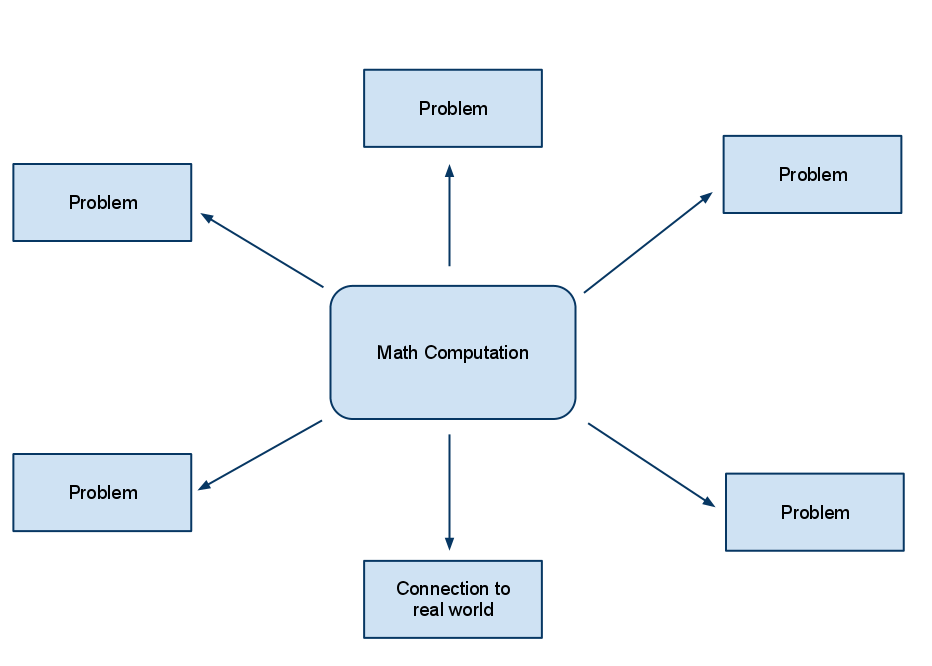
Math computation at the centre

The computations we want students to be able to do are chosen, and then we find problems that match these computations, and if we are able, we find some real life connections to the computations. Generally the real world connections are an after thought, and many times teachers are responsible for finding these connections when the textbook problems they are given are really examples of pseudo-context rather than a real connection. It can be difficult to attach real world context to the curriculum we are expected to teach and many times teachers aren’t able to do it.

There is a serious flaw in how this curriculum is constructed. The mathematics that is chosen has no motivation in the minds of the people learning it. If you have wondered why so many people hated mathematics class, it was because they couldn’t see the point of it. That’s because there was no point. People who hate mathematics were learning apparently meaningless algorithms for the sake of the algorithms themselves rather than for the processes in our world where the algorithms describe.

What if we flipped this process? What would happen if we changed the diagram so the real world problems were in the middle of the diagram, and we chose what mathematics to look at based directly on how it helped us understand the real world? The diagram would look like this:
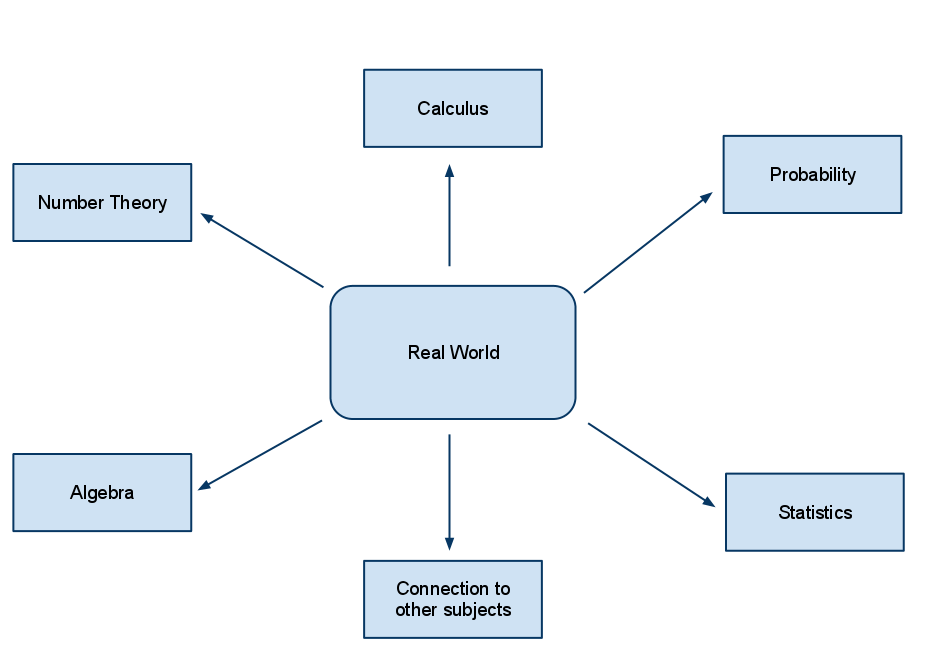
Real world at centre

I need to be careful here to define “real world.” I do not mean that students will spend their time learning how to solve the math problems that may arise in their life like an endless stream of super-market math. What I mean by “real world” is that the problems students would work on would have a shared context to which students will understand. This context might be a real problem that students or their teachers find, it might be part of an interesting challenge given to them by a mentor, or it might be simply exploring ‘what if’ in a puzzle.

The thing is, when you place context at the centre of the curriculum an immediate shift happens. Now the mathematics itself has immediate relevance, since the applications are focused on something which has meaning for the students. You also gain the ability to shift away from a computational focus (since that’s what should be for) and look at problem formulating and solving. Gone is pseudo-context. Gone is mathematics which has no relevance in the lives of our students.

Formulating the curriculum like this also makes finding connections to other areas where the students are studying much easier. Everyone can talk about the real world, and it can happen in every subject area. It becomes easier to turn our curriculum from caged subject areas into an open dialogue about life.

It also becomes easier to update the curriculum. The topics of a typical mathematics curriculum have changed very little in the past 100 years, and are nearly universal across the globe. However, in this curriculum the focus is on what is happening in real life, and it becomes easier to select what is important to teach as all of us experience the real world daily. In fact the curriculum itself could easily change from year to year and the actual mathematics that is taught could be different in each school. After all, what is important in mathematics is the process that students go through, not the end result.

There is also room in this model of curriculum for fairly advanced topics. You can see that calculus could be one of the branches of this type of curriculum since it deals intimately with understanding many complex phenomena in our world. If a student wants to extend themselves and get excited by the mathematics itself, we can still give them that opportunity. We can be more flexible in how we plan our lessons and give students more choice in how they approach problem solving.

What is not easy to represent in this diagram is what the arrows, which are common to all of the different possible branches of mathematics and their representation to the real world content. In my mind, these arrows represent part of the process of translating a real world problem into mathematics. Students have to know how to formulate problems, develop criteria for establishing what pieces of information they have are useful, and determine if their solution makes sense. Since they know for certain that the solution represents a real world phenomena, it will be easier to judge a correct solution from an obvious false one.

This shift also makes it easier to talk about the big ideas of mathematics. Most of the time we spend our classroom time so focused on the minutia that we forget that there are some powerful ideas in mathematics that are useful tools for thinking for students.

Here is a presentation to explain some of what this shift looks like for me.


Mathematics education has to change. I have spent my life either feeling defensive about my love of mathematics, or commiserating with people who agree with me. People say that they hate mathematics because they do not see how it is relevant. Let’s change mathematics curriculum so that context (which does not necessarily have to be “real world” but should be meaningful) is king.


Update: In my current work as a curriculum developer, I’ve been working on an alternative to the proposal above in our curriculum work which embeds contexts where they are meaningful but does not flip the arrangement as above. The key shift in our curriculum work is viewing students as sense-makers and fore-fronting student thinking as much as possible while still making mathematics accessible to all students (through shifts in instructional practices rather than shifts in the mathematics itself).

The Prisoner’s Dilemma as it Applies to Education

In the prisoner’s dilemma scenario, two prisoners are each interviewed separately and asked to cooperate with the authorities. Here is an except from Wikipedia on the dilemma.

"The classical prisoner’s dilemma can be summarized thus:

  Prisoner B Stays Silent Prisoner B Betrays
Prisoner A Stays Silent Each serves 6 months Prisoner A: 10 years
Prisoner B: goes free
Prisoner A Betrays Prisoner A: goes free
Prisoner B: 10 years
Each serves 5 years

In this game, regardless of what the opponent chooses, each player always receives a higher payoff (lesser sentence) by betraying; that is to say that betraying is the strictly dominant strategy. For instance, Prisoner A can accurately say, "No matter what Prisoner B does, I personally am better off betraying than staying silent. Therefore, for my own sake, I should betray." However, if the other player acts similarly, then they both betray and both get a lower payoff than they would get by staying silent. Rational self-interested decisions result in each prisoner being worse off than if each chose to lessen the sentence of the accomplice at the cost of staying a little longer in jail himself (hence the seeming dilemma). In game theory, this demonstrates very elegantly that in a non-zero-sum game a Nash equilibrium need not be a Pareto optimum."

So how does this apply to schools? Let’s replace the word "prisoners" with students and the word "authorities" with "school administrator or teacher." We actually replicate the exact circumstances of this dilemma in schools every time we "try and get the bottom" of a situation between two students.

Instead of the highly negative choices for the students being prison sentence, they are detentions, or reduction of marks, or a million other consequences we apply to children when they misbehave. Further, children will apply their own consequences for "snitching" so that even if the adult administering the punishment goes easy on the child who tattles, and acts harshly on the child apparently "responsible" for the dilemma, there is often a consequence for the child who tattled; they may be ostracized by their peers or even face physical violence.

A typical analysis of the prisoner’s dilemma indicates that the optimal choice for players of the game is to remain silent and accept the minor punishment, even if they haven’t committed the crime. When we place school children in the same situation, don’t they react exactly the same way? This is not what we want, simply because in order to help a child who has misbehaved, we need information in order to help them. We need to understand what is going on so it is not repeated over and over again, as is normal in unresolved disputes.

There are two solutions I see for resolving the prisoner’s dilemma in schools. One, don’t isolate the kids and have the conversation about the misbehaviour as a group. This breaks the conditions of the prisoner’s dilemma as now each participant is aware of the other’s response. Two, change how you define misbehaviour so that you don’t end up in this situation. My recommendation, if you are more interested in the second of these options is to check out Restitution, although I am sure there are other ways to do this.

A Democratic Education

Joe Bower posted this video on his blog.

Joe writes:

If we really cared about real accountability, we would first ask if kids like school, and then we would have to care how they answer. Until then, kids will continue to be victims of a system that cares more about sustaining its current self than serving students.

Here is my response which I left as a comment on his blog:

I love this video Joe. It frames what I believe to be true about education in a way which is catchy, interesting to watch, and (I feel) hard to argue with.

When we share these ideas with other people, they keep going back to the same argument: how will we know kids are learning?

So I think our challenge is to come up with an answer to that argument which parents will accept without having to make too much of a radical change in their life.

I mean, I know my son is learning because I spend a lot of time with him and I keep track of the changes I see. I know he’s learning because I listen to the questions he has. I know he’s learning because I catch him trying to read (he’s 4). I know he’s learning because I’m involved deeply in his life. I want this to always be true, although over time I also want him to really learn the skill of autonomy, so I want to be a participant in his learning, rather than the sole director of it.

Our system of education absolves parents of the responsibility of paying attention to their kids learning needs by giving them easy numbers and letters to look at which are substitutes for the measures we already have for learning. You will know your child is learning if you are a part of the process, and pay attention.

Our economic system requires that parents work harder than should be necessary to support themselves, often leaving them without the time to support their kids emotionally. Something is flawed with a society which devalues the relationship between parents & kids and suggests that only a stranger can best teach your child everything they need to know. 

The transformation in our education system will happen when we give students real choice about what they learn, when we take away the barriers to developing individuality, and when we stop pretending that it is possible to carefully select the curriculum students will learn from the millions of useful things they could be learning. One size fits all doesn’t work. There is no other industry I can think of which believes that every one of their "customers" has the same needs.


Sometimes the Technology is Necessary

We can argue that good teaching doesn’t need technology, and I’m going to agree with that. There lots of really powerful learning opportunities you can do with students that require no technology at all. In fact, if it works better without the technology, don’t use it. You are just introducing the risk that the technology will fail and your lesson will flop.

However, there are some things you cannot do without technology, and they are interesting and engaging learning opportunities for your students.

For example, I want my students to understand that when a ball bounces, the heights of each bounce closely match an exponential function. We’ve talked before how they match a decreasing geometric sequence, but I want them to really see and understand this phenomena.

So I had students first video record a ball bouncing, and then use this video recording to accurately record the heights of each bounce. Students did their recordings, and right away had questions. Here’s an example.

The thing is, you can’t accurately find the heights of the bounces without technology. Trust me, I’ve tried. I’ve had students measure with meter sticks and do 10 trials and find the mean of the heights, and all sorts of other tricks, but every time there is at least one group with really bad data. Data which makes the whole point of doing the exercise useless. You really only need to learn the lesson about experimental error a few times before you either give up, or find better ways of collecting your data.

Here are some examples of what the students did to find the heights of the bounces. What I found interesting is that they didn’t really use new technology to do their measurements, they relied on what they knew how to do, which is measuring with a ruler. So I would say this activity so far is a mixture of new technology and very, very old technology.

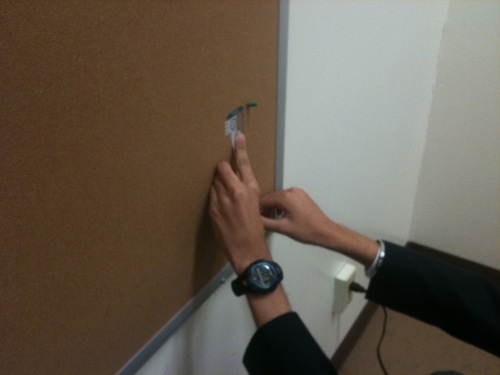
Student measuring on a wall

Notice the student (in the photo below) is using stickie notes to keep track of different positions of the ball at different times. I really thought this was a creative way to help make the measurement taking easier.

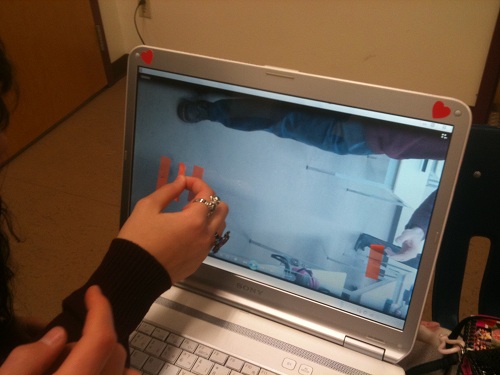
Student measuring on their laptop

Here a student is measuring the distance directly with their ruler. At this point we had a great conversation about what this measurement meant. The question the student asked was, how do I find the actual distance the ball travelled during a bounce? She answered herself, and realized she could use the scale of the relationship between the height they dropped the ball on the screen, and the real world height. I pointed out that they could save themselves some effort, because the relationships between the bounces (what we were interested in) did not depend on the actual heights of the bounces, only on their relative heights.

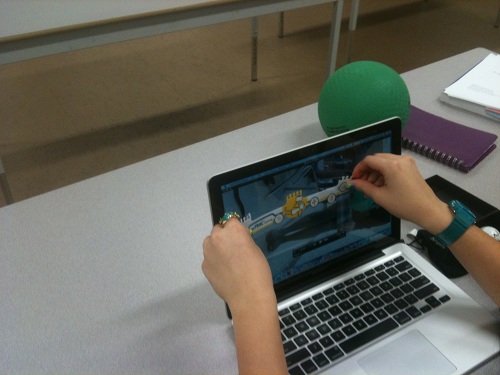
Student using a ruler on a laptop screen.

So what we see a mixture of technologies the students are using and some obvious opportunities for learning to occur.

The technology is sometimes necessary to teach a particular concept in a constructivist way. In this case, the technology greatly increases the accuracy of the measurements the student is making. It makes enough of a difference that in the regression analysis the students did (using a spreadsheet program which is another useful technology) all of the students discovered that an exponential function is the best fit function for their data.

To make this point even more obvious, check out this high speed video footage of a drop of water landing in a pool of water.

You can’t see this phenomena clearly without technology to slow down time for us. It just isn’t possible. Some things worth learning in schools are impossible without using the appropriate technology.

School Bells Interfere With Learning

I hate being interrupted in the middle of a good learning session with my students. It has happened hundreds of times in my career because of an archaic device we use in schools known as a clock. The clock itself isn’t evil, but the way we use it in schools has serious ramifications on how our students learn.

First, because we partition students into neat packages called subjects, they are implicitly taught that learning is something we do in compartments. If you try and introduce a little bit of another subject in your subject, students object, saying "This isn’t English, Mr. Wees. Teach us Mathematics." (I’ve actually had students tell me that). Where in the real world is learning sectioned off like this? Mathematics use English (and other languages) when they explain their discoveries to other people. Biologists use geography to decide where to start their research. All of what we learn is interconnected, and more of these connections need to made obvious to the students. This is not easy to do in a school with nine 45 minute separate blocks.

Next, we tell students to stop working on a particular project when the time is up. We enforce time limits on learning! While I’ll grant that real life has deadlines and limits, it very rare indeed that someone has to complete a task "within the next 15 minutes because class will be over" (I’ve said this in my classroom, so many times I can’t keep track). Maybe you have to finish something by a particular day, or by the end of today, but you are in charge of how much you work on the subject, and not the clock. It is ridiculous the number of times I’ve seen students actively engaged in learning and have it wrecked because the end of class came. Worse, I’ve filled the last 10 minutes of a class with a meaningless activity just to ensure that I use every minute I’ve got.

We also assume that each subject area needs the same amount of time each week, and try to make sure that everyone gets their equal share of the carefully apportioned time for courses. In our school I teach IB Mathematical Studies, which requires at least 150 hours of in class instructional time. My school has carefully arranged for about 160 hours, just in case I lose some to field trips, student illness, snow days, and other time sinks. Oh right. Field trips, those banes of our teaching existence which make it so hard to plan. It’s not like any REAL learning happens during field trips anyway.

Clocks are part of the systems world of a school but they have come to rule our life world. We have let ourselves become subject to fixed schedules, daily routine, and the drudgery of a factory-like system. I’m not saying that we can do without the clocks, but maybe we need to find ways for our system to be more flexible, to allow the learning to extend when necessary, and even send off kids early for another opportunity to learn, when their lesson with us is done. Maybe we should even rethink how we schedule kids, and consider other instructional models. There are schools where there are no bells, no classes like what you would see in a traditional school, just kids (and adults) learning.

The Problem with Award Ceremonies

@MrWejr and @GCouros have both recently posted about award ceremonies. I felt like I could contribute to the conversation, and I agree with their arguments. I just have a couple of other points to add.

George wrote a post called "Honoring All Students" in which he describes a two possible sets of students; those who receive rewards and those who do not. The students who win awards tend to focus on the awards themselves, rather than the activity they are being rewarded for. In fact, he links to research Daniel Pink has collected showing that rewards (and by extension awards) are detrimental to processes which require critical thinking. It is obvious that students who fall into the other camp will either be indifferent to the awards (or at least externally so) or feel hurt that they haven’t won an award. George also contents that having award ceremonies is for the adults, not the kids.

Chris writes 

June 1, 2010 marked the end of a tradition at our school – a tradition that awarded top students not for their efforts and learning but for their grades and achievements. The staff at Kent School decided to abolish the “awards” part of the year end ceremony.

His post is inciteful and interesting, and rather than quote all of it here, I recommend reading it.

Both of these posts are mentioned in a Vancouver Sun article suggesting that award ceremonies may be losing favour in BC schools. The comments on the article are either praising the ending of the practice at Chris’ school, or lamenting the end of the practice. The argument in the comments is quite interesting, but I find the arguments against awards to be mostly inciteful and well thought out, while many of the opposing comments are one-line sentences making fun of ending awards, like Chris isn’t an intelligent person with reasons behind his actions.

Both Chris’ and George’s well written blog posts come from a student centred perspective of educational philosophy. Rather than focus on the tradition of awards or our personal feelings about being awarded (or not being awarded) they focus on the outcome for the student. They ask the question, "Are awards helpful in promoting learning?" and both find that the answer is No.

There is another argument against awards that doesn’t rely on your perspective. I think it is a much weaker argument than whether we should approach awards from the student’s point of view or not but it is worth mentioning. The argument starts with the question, "How do we choose which students are awarded?"

First, we will assume that if you are handing out awards that you aren’t giving them to every student, because otherwise they wouldn’t be an external recognition of success, they would just be something everyone gets.

So now we aren’t giving the awards to everyone, we have to choose some criterion to select which students get awards. Those criterion will always be subjectively chosen and therefore it is impossible to objectively give awards to students. Awards based on grades will have bias since each teacher will be grading differently. Awards based on the judgement of a panel of teachers have obvious bias since each teacher will be rooting for "their student" (I’ve been involved in selecting awards in teacher committees before).

Awards for students seem like such a powerful message. "We appreciate what you do." It is a good message to send, but sending it once at the end of the year in a public assembly is problematic. It says, "we will reward you for your hard work but only in this special public way." Worse, when the message of recognition becomes a reward, especially a reward given frequently, it turns into an ugly monster where children stop being interested in what they do, and become dependent on the external motivators, or even demotivated by the awards.

Schools should be places where students love learning for the sake of learning, not for external rewards.

Using Microsoft’s speech recognition: helping my stepfather manage Parkinson’s

This is a new document that I’m typing using only Microsoft speech recognition. The cool thing about dictation is it allows people who may not have the ability to type documents to still be able to write. From start to finish, this document has been created using dictation.

My stepfather has Parkinson’s disease. He has been struggling with the disease for a couple years now and the conditions of the getting steadily worse. His mind is as clear as ever, but his body is struggling and he has constant tremors. He wants to be able to write, he has three different books he would like to finish, but he is concerned that the disease will prevent some from being able to share his ideas.

I suggested Dragon Dictation as an option for him, and he likes the idea of being able to dictate his writing. The cost of Dragon Dictation doesn’t seem too much, but I think he’ll be happy with my discovery that Microsoft speech recognition is actually pretty good. He can get started with his dictation right away.

NY State Regents exam in Mathematics: Fair or not?

I was reading an article on the Huffington post tonight that suggested communities should boycott standardized tests. Some of the comments seemed to support the current tests, with the comment “I took tests in school so why shouldn’t these kids?” and other similar arguments. It occurred to me that maybe these people don’t actually KNOW what a modern standardized test looks like? It then occurred to me that, except for parents who are sent home practice material, that many people outside of education don’t know what the tests look like.

Here’s a link to the August 2010 NY Regent’s exam in Integrated Mathematics. Let’s take a look at it so you can see why I’m opposed to standardized tests.

First the front page.

Front page of August 2010 paperThis is too much text. An entire page of instructions for a single exam? It is difficult to follow a couple of simple instructions, but an entire page is a bit ridiculous. If you’ve tried getting adults to follow some simple instructions in an important email you send them, then you’ll understand my point here.

“Print your name and the name of your school above.” I mean seriously, do they think the kids are stupid? The two lines above say quite clearly “Student name” and “School name”. What the hell else could they mean? Treating kids like they are idiots is not the best way to start off an exam. This could be an instruction for the invigidulator to read out to the students to remind them to include their names. Nothing is worse for a teacher than receiving an exam in which a student has put a lot of work, but has forgotten to include their name. However, it is not necessary to print out instructions which are completely clear from the previous two lines.

You can’t see it this small picture, but at the top and bottom of the exam paper, it says “Integrated Algebra” and at the bottom of the paper, it is written upside down. This is clearly not for the student, it is to help the invidulator of the exam keep track of what exam each student has. It’s probably an anti-cheating measure, but it is a distraction and unnecessary. It says in ENORMOUS BOLD TEXT at the top of the page which exam the student has.

In a big giant box there is a notice on the exam. It says “A graphing calculator and a straight-edge (ruler) must be available for you to use while taking this exam.” This is not really a message to the students, who would be powerless to react to this notice if this exam was in front of them, it is really a notice for the schools administering the exams that they are responsible for ensuring that their students have access to the necessary tools. Instructions like this should be sent to the school, not to the students themselves, or at least should be worded in a less aggressive tone. For example, “You may use a graphing calculator or a straight-edge (ruler) for this exam. All other aids are not permited.”

Now let’s look at the questions themselves.

Questions 1, 4, 7, 18, 20, 23, 24, 32, 34, 38, and 39 are all word problems apparently intended to be based on “real-life” examples. Every one them is an example of a classic @ddmeyer “pseudo-context” problem. They attempt to model real life, but do a very poor job of it. No one would ever try to actually solve any of those problems in real life. By including these types of questions on the exam, textbook companies now have to create similar problems for students and teachers (the majority of whom unfortunately rely on the textbook for their classroom practice exercises) have to teach those similar problems. Now you have a case of a standardized exam reinforcing bad pedagogy.

Worse, these questions all have built in cultural references students have to decipher in order to be able to do the questions properly. When I taught in NY state, I showed kids how to draw a line through the parts of the question they didn’t understand and then try to decipher the actual mathematics they were being asked to do. What is the point in having a description of a problem at all if many of the students who will take the exam won’t understand your descriptions?

The other questions on the exam are all computational style questions. None of them has any attempt made to make them a relevant question, they are apparently uninspired by reality at all. Of course now we have the same problem as the other set of questions! Textbook companies will now have to print questions just like these from the exam, and again, teachers will use them. Guess how many students in NY state will get to solve really interesting, well motivated problems using mathematics? Some will, but I bet most won’t. What a shame.

The first 30 questions of the test are all multiple choice with the other 9 questions being broken into two parts somewhat arbitrarily between the easier short-answer questions, and some harder longer-response questions.

Multiple choice questions are awful. Students choose between similar sounding answers, each of which has been chosen either to match a misconception or miscalculation the students can make. Only one of the answers is correct. These questions are multiple choice for one reason only, because it saves NY state money in marking the exams. If you really wanted to find out what students were learning in the schools, you would use a deeper assessment tool.

The exam is translated into 5 languages other than English. This is a great start, students who read and speak those other languages can now have a better chance to take the exam. However, 170 or so languages on the planet is spoken in New York City. What about the other 164 languages? Why aren’t their translated editions of each exam for those languages? Oh right, it would cost too much money. Having a few translations of the test is not sufficient to addressing the inequity of testing students in something other than their mother tongue.

There are many other flaws with this exam. I have a lot of other questions about choices that have been made in its construction. Why 39 questions, for example? Why not 38? Is this so the exam “fits” into a neat time frame? How has the curriculum been chosen? Is this the best set of things students should learn at this age? Does any of this mathematics have relevance in the real world?

Standardized exams like this NY state assessment are destructive. Poorly constructed exams are used to draw inferences about the schools in the state, provide funding for schools based on performance targets, and soon they will be used to decide how much individual teachers will be paid (if the merit pay reform goes through across the US).

You cannot fairly measure a school using a broken metric.