Education ∪ Math ∪ Technology

Author: David Wees (page 43 of 98)

5 little monkeys

At Edcamp Delta, Brad shared the following parable with me.

In the parable, researchers supposedly put 5 monkeys together in a cage, and in the cage there were some steps leading to some bananas. Whenever any of the monkeys would start to go up the steps to get a banana however, the hypothetical researchers would spray all of the monkeys in the cage with cold water. Every time any one of the monkeys went to get a banana, the entire group would get sprayed with cold water. After time, the monkeys would self-regulate and would attack any monkey that tried to make a move for the bananas, and the researchers stopped spraying the monkeys with water.

In the next stage of the experiment, they removed one of the original monkeys, and replaced it with a new one. The new monkey, not knowing about the cold water, would eventually decide to make an attempt to get one of the bananas, at which point the other four monkeys would attack the new monkey, preventing it from getting a banana. Over time, the new monkey learned not to make an effort to get a banana, and even though it had not experienced the spraying of cold water, it learned about the aversion to going to get a banana.

Over time, the researchers replaced each of the original monkeys with a new monkey, and each time, the new monkey learned not to attempt to get a banana as the other monkeys would beat it up. In other words, the researchers learned that the monkeys had passed along a cultural adaptation (avoidance of getting bananas) without having the original reason for the adaptation still present.

There was an experiment done with monkeys in the 1960s which is likely from where this parable was derived. Stephenson was able to train monkeys to avoid touching an object with blasts of air, and discovered that these monkeys could transmit this aversion to a ‘naive’ colleague (Stephenson, 1967). So while the parable seems to have never actually been tested, the results from Stephenson’s experiment suggest the parable is believable.

The point of this parable is that we can often repeat patterns as a form of peer pressure without understanding the original reasons for the behaviour. While we have an advantage over monkeys, which is that we can clearly articulate to each successive generation the reasons for a particular action that we take, unfortunately, we often do not share our reasons with the next generation, and only share the rules that we have established.

We see this experimented repeated over and over again in society. For example, suppose that in a subway station a door was locked in the early morning, and another door was unlocked. The first people to arrive at the subway station, not seeing anyone around, will test both doors, and enter through the one that works. Eventually traffiic gets a bit higher, and the door that works is always open because of constant traffic through the door. The other door, which doesn’t work, is assumed to not work since no one seems to be using it. If a custodian came by and unlocked the door, it wouldn’t be used, until someone came and actually went against the grain and tested the other door. We could call this person who tests the other door, even though no one else seems to be using it, an innovator.

Cultural pressure to follow what we’ve always done before, without really understanding the reasons why we follow the actions we do, is quite strong. How many of our structures in schools are done in certain ways even though the restrictions on doing them in other ways no longer exist?


References:

Stephenson, G. R. (1967). Cultural acquisition of a specific learned response among rhesus monkeys. In: Starek, D., Schneider, R., and Kuhn, H. J. (eds.), Progress in Primatology, Stuttgart: Fischer, pp. 279-288.

I could use some help

I’ve been invited to do a keynote on the topic of educational technology for the University of Alberta at their Technology Fair for their student teachers and education faculty on February 13th. See http://www.educ.ualberta.ca/technologyfair/ for details on this conference.

I’m working on the keynote, and I could use some feedback. There are aspects of what I’ve written that I’m happy with, and others that I think need improvement. I’m not planning on reading this verbatim, but it will inform how I construct my slides, and speaking notes for the keynote. If anyone can give me some feedback, that would be greatly appreciated.

You can either comment on the keynote directly, or leave me a comment here. Thank you in advance for your assistance.


Are teachers overpaid?

Two authors of a controversial paper from the Heritage Foundation suggest that teachers are overpaid for their efforts. Here is my response.

The US economy dropped by 15.6% in 2009 for a total loss of $2, 342, 400, 000, 000. The people responsible for this disaster to the economy almost all received million dollar bonuses for their efforts.

From this I can deduce that the relationship between compensation for one’s "work" and what one does, or knows how to do, is not as straight forward as the authors of this paper claim.

All compensation is political. We choose to compensate some people differently than others for historical reasons, for political reasons, and obviously for economic reasons, but to ignore the historical and political aspects of compensation is to make a grave error in one’s research.

Thoughts? Do you think teachers are overpaid?


Is my son a writer?

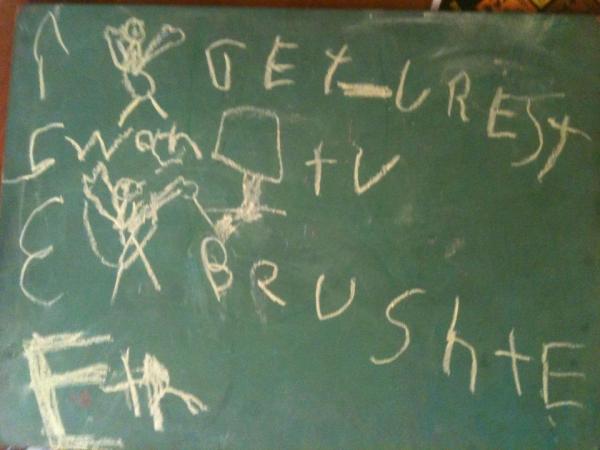
This is a list my son created of things he wanted to make sure he got done for the day.

Writing a list


Does this make my son a writer? Is it more important that he is attempting to use text to get out his thoughts? Or is it more important that I help him correct the mistakes that he has made to make him a ‘better’ writer?

I’m of the opinion, at least at this stage, that we allow our son to make mistakes without being overly concerned about correcting them. Once he learns how to read, he will naturally learn how to spell better, and he will also learn more of the rules about how we write things down. At this stage grammar, and structure are somewhat unimportant, and just being willing to experiment and make an attempt is of critical importance.

What do you think?

Bicycling with my son


One of the first times my son rode his bicycle.


I went bicycling with my five year old son yesterday with his new bicycle from his Birthday. We haven’t had much of a chance to bicycle recently together, so my son hadn’t actually ridden his bicycle since the summertime. As a result, he had really forgotten a lot about what he learned over the summer about riding bicycles, and was really struggling to even get his bicycle going.

As the minutes wore on, he became more and more frustrated, although I was encouraged by his willingness to fall down and then get right back up over and over again. I did give him some advice and encouragement during this time, but since I knew he was capable of riding his bicycle, I didn’t want to be too helpful.

I realized that he had forgotten what it felt like to ride his bicycle. He was on an unfamiliar bike that was just a wee bit too large for him, and just couldn’t seem to get it together.

So I asked him to pause for a second, and get off his bicycle. I knelt, and we were face to face, and I asked him if he remembered riding his bicycle before. He said he couldn’t and his face fell a bit. I asked him if he remembered riding it down Auntie Juniper’s driveway (which is where he first learned how to ride his bicycle), and his face lit up while he nodded vigorously. I asked him to close his eyes, and imagine himself riding down Auntie Juniper’s driveway. He closed his eyes and I reminded him of how much practice he had put in, how much fun he had during the summer, and how good he had gotten at riding his bicycle. We spent about two minutes remembering together the feeling of the first time he rode a bicycle.

Right after that, he got back on his bicycle and started to ride it. He only fell down one more time while riding his bicycle, and even managed to ride it all the way around the park twice without stopping (he was pretty proud of this accomplishment). He went from unable to get his bicycle going more than a couple of feet to being as capable as he was during the summer after all of his practice.

This incident reminded me of a few things about learning:

  • What you know how to do is tied to your emotions. It is not enough to simply know things, you have to have some feelings attached to those things for them to be useful. When my son lacked confidence, he wasn’t able to ride his bicycle. When he regained his confidence, and remembered the joy he felt riding his bicycle during the summer, all of his knowledge about how to ride a bicycle came back to him.
     
  • Focused and contextualized practice are important in learning. You can’t really get better at riding a bicycle by talking about riding a bicycle, you have to do it. My son spent many hours riding his bicycle in order to become better at it.

    Although I see the obvious value in learning in practicing, I want to re-iterate how important it is that this practice be in a meaningful context. I often see comments on stories about mathematics education, for example, where the people talk about this or that cashier who was unable to make change without a calculator and how this points to an obviously sorry state of mathematics education. The question I want to ask in response to the often repeated story of the cashier is, when did they practice making change? They practiced arithmetic repeatedly in schools, no doubt, but how many schools have students play the part of cashiers and make change for pretend customers? How often is the skill of arithmetic practiced in context?
     

  • Practice should be part of a shared experience, and should have a positive emotion attached to it. If my son had learned how to ride a bicycle on his own, I wouldn’t have been able to help him remember his previous experience. If he had spent his entire time practicing in frustration or in anger during the summer, I doubt he would have remembered how to ride his bicycle yesterday.


Calculator vs Slide Rule vs Hand calculations

In an excellent post Michael Doyle says the following:

Electronic calculators are abstract, abacuses are not.
Slide rules fall in-between.
Our sense of quantities has become abstract.


Here is my comment back:

It’s not so much that numbers are abstract to students, but our representations of those numbers (the numerals that make up 122) are abstract.

Base 10 is a much more complicated concept than we give credit to in our teaching of it.

How many people are fooled by the numbers thrown out on the news (example: 12 millions dollars over-budget, on a budget of 1.3 trillion)?

The scale on a slide rule is a logarithmic one, and so it breaks the intuitive linear sense of numbers that we are born with. Hence, I don’t think it’s necessarily the case that the scale helps us understand the operations any better. A slide rule is a calculator, it just uses slides instead of buttons, and the operations are just as mystifying to most people.

Similarly the operations on a calculator (or the standard algorithms we teach kids to use on pencil and paper) are just as mystifying. Regardless of which algorithm one uses, one should have an understanding first of what the expected outcome of the algorithm should be, which unfortunately, we spend almost no time teaching in our mathematics curriculums.

It has become more important to do operations quickly and accurately to demonstrate "computational fluency" and error checking, a MUCH more important skill, has fallen by the wayside. Being able to estimate or predict the outcome of an algorithm is not only a far more useful life-skill than accurately calculating it (when one wants accuracy, one should use the correct tool) and further, it requires actual understanding of the process.

I think Michael is right that our sense of quantities is abstract, but I think that this has always been true for most people, regardless of the form of technology we’ve used to do our calculations. It is not so much the calculator that is the problem, but the embedded abstraction in numerals themselves. Unfortunately, we spend much more time teaching kids how to do operations on numbers, and I don’t think we spend enough time teaching about what the numbers themselves mean (or at least on reminding students what they learned in previous years on numbers). For example, in the BC curriculum, the discussion on the relative size of numbers seems to stop in grade 6.

It is too easy to blame kids lack of fluency as adults with numbers on the technology used to do calculations with those numbers. Instead we should ask ourselves, where have we taught them fluency with numbers? How have we helped them learn about the abstraction numbers represent?

Actual engagement

Online Schools is now following you!


A Twitter user named "Distance Education" with the user name ‘onlinecourse’ has followed me 25 times. This suggests that they have also unfollowed me at least 24 times. This kind of behaviour I’ve heard called ‘follower-churn.’

I may have accidentally unfollowed someone, and then followed them back. I certainly haven’t been using this to gain followers. I follow people because they are interesting to me, and I manually follow each person I find, after reading through some of their tweets. It’s a bit onerous, but it does tend to ensure that I get a better selection of information from the people I’m following.

Distance Education is currently at 6565 followers. I have roughly the same number.  Who do you think is interested in actual engagement, and who is just looking to pad their numbers? Hint: It’s called social media for a reason.

We’ve had email for 40 years – and people still don’t know how to use it

The topic of email has come up recently at my school, and while I appreciate that my staff knows how to use email fairly effectively, it is surprising to me that 40 years after its invention, many people still don’t know how to use email.

  • People still occasionally hit reply all instead of reply
  • People send emails to huge lists of their friends using CC instead of BCC.
  • Many, many people have hundreds of unread emails in their inbox.
  • People respond to scams sent via email.
  • People download attachments or click on links in email from people they don’t know, and infect their computer with viruses.
  • Many people do not how to either search through their email, or organize it into folders, leading them to email requests like "send that email to me again."
  • People use email to forward chain letters.
  • People use email to have conversations that would be faster and more efficient in person.

To be fair, I’m sure that other forms of communication over the years have been inproperly used. It just seems strange to me that something which could have such an obvious value; asynchronous communication with anyone, anywhere in the world, for free, isn’t more firmly established in the educational community.

On another note, just as most educators are using it, email may be dying. Spam, an overload of subscriptions, and the abuses of email I listed above, are all combining to make this tool, which could be useful, less productive than more restrictive communication environments, and so the younger generations aren’t using it. One of the chief advantages of Facebook and Twitter for asynchronous communication, is the ability to disable specific people from sending you messages, and to turn off messages from people you don’t know.

Unfortunately, communication tools are only useful if many people are using them, and what we will lose if and when email stops being used, is the ability to send messages to people we don’t know very well. This is especially problematic given that the postal service is also seeing a huge decline in usage. Will we end up in a world where the technology exists to communicate with people who are different from us, and we just won’t be using it?


How can we evaluate our use of educational technology?

At Edcamp Fraser Valley, I facilitated a conversation on the use of educational technology, focusing on the issue of evaluating its use. The framework I shared (created by Bates and Poole, see below) was the SECTIONS framework, which I have found to be a reasonably comprehensive approach to examining educational technology, depending on how you unpack it. This framework reminds us that we need to think about students, ease of use, cost structure, teaching and learning, interactivity, organizational issues, novelty, and speed, when examining educational technology.

At the beginning of the session, I started by recommending starting with students, teaching, and learning when using these frameworks since a primary purpose in using technology should be to improve teaching and learning, with a focus on the effect on student learning. Here is a summary of some of the various points that were brought up during the session.

  • Students:

    Is the technology accessible for all of your students? Many (if not most) Flash based applications are nearly useless for your severely visually impaired students, for example. Videos without subtitles are extremely difficult for hearing impaired students to follow. Text based technology might be gibberish to students who are struggling with literacy issues.
     

  • Ease of use

    How easy is the technology to use? Will learning how to use the technology interfere with the ability to use the technology as a tool? Will students spend ages booting up computers (4 minutes a lesson is 12 hours of wasted instructional time over the course of a year!)?
     

  • Cost structure:

    Compare the cost of the technology to what it allows you to do. Some technology is cheap and can be used in a variety of different ways. Some technology is expensive (both in terms of time and money) and can only be used in one or two ways. The benefit to cost ratio of technology should be as high as possible. Further, do not forget to evaluate the environmental cost of the technology. 
     

  • Teaching and learning:

    This is what you should look at when evaluating a new technology right after establishing it’s accessibility. What pedagogy am I trying to support with this technology? Does this technology support new modes of pedagogy? Will this technology improve student learning (or at least provide affordances for student learning)? How will I know if this technology is effective? Has any (independent from a vendor) research been done to evaluate this technology?
     

  • Interactivity:

    Is this technology interactive? Does it provide opportunities for the learner to get feedback about what they are doing? Is the technology doing something that you can’t already do without it?
     

  • Organizational issues:

    Can your organization support this technology? How will you maintain it (if needed)? Does its use fit your organizations mission and values? Do you have sufficient staff to provide training and support for the technology? If not, what staffing ratios will it require? How will you train staff to use the technology (if necessary)? Will the technology even be used? One participant noted that, when cleaning out a closet, he found unopened packs of teacher resources. What a waste of money!
     

  • Novelty:

    Choosing a technology because the novelty of it will temporarily engage learners is a bad idea. If this is the primary reason you are using a technology, you’ll find yourself needing to switch to a new technology on a regular basis without sufficient time to evaluate each of the successive technologies. Further, it will make it challenging to evaluate the effectiveness of the technology for long-term use. Was the technology useful for students because of inherent qualities, or because they just hadn’t used it before?
     

  • Speed:

    How fast is the technology? Will significant time be spent waiting for the technology to do its job? Is there another equivalent technology that could be faster?
     

After more time considering the issue, I’d add one more item to the SECTIONS framework which I think is hardly ever considered.

  • Culture:

    How will the use of this technology affect the culture of your organization? How will this technology affect our greater society? As Neil Postman notes, no technology is culture-neutral. Will our society change as a result of this technology? Is this change desirable? What would we do if we used technology, and found that the changes in our society (or environment) were undesirable? Could we stop using the technology? There is enormous inertia behind the use of technology in society, and technologies are very rarely abandoned.

Technology which is unevaluated before its use could be ineffectively used, wasteful, or even harmful for students. It is irresponsible to use technology with students without some expectation of the outcomes of the technology. While I support experimentation in the use of technology (and maybe not having all of the answers about the effectiveness of the technology in advance), this does not mean that one should not think critically about the use of the technology before using it. 


References:

Bates, A.W., and G. Poole. (2003). Effective teaching with technology in higher education. San Francisco: Jossey-Bas.

Postman, N. (1998). Five Things We Need to Know About Technological Change.