The Reflective Educator

Education ∪ Math ∪ Technology

Archives (page 50 of 98)

Standardization is impossible

Stop light
(Image credit: photoburst)


Stop lights are a rule. They are a standard system used worldwide as a solution to the problem of people getting into accidents at intersections.

However, what most people don’t know (unless you have travelled a lot, or lived abroad) is that different cultures treat stop lights differently, particularly for pedestrians. In New York City, the red light means "walk across unless someone is driving through right now" on a cross town street, and "don’t walk" on a uptown/downtown street. In Vancouver, the red light means "be careful crossing the street" if it is a quiet street, and "don’t cross" (unless you are a rebel) for a busy street. In London, a red light means "stay the hell away from the road" because cars will run you down if you try and cross, but a crosswalk means, "expect traffic to slam on their brakes to let you cross". In Bangkok, you don’t cross at intersections, you use the overhead walkways. In Hamburg, the red light means, do not cross under any circumstances, even if you can’t see traffic in either direction for miles. In Rio de Janeiro, at night time, the red light means, honk and drive on through, as no one wants to stop in case they are carjacked (anyone who walks around Rio at night time is crazy).

The point is, this seemingly universal symbol still has a local meaning, even though effort has been made to adopt the same system all over the world. Rules are culturally situated.

Our society’s push to standardize education needs to recognize that even in a standardized system, there will be local variance. Schools, just like municipalities adopting traffic lights, need to work the external system into their local framework, and the expectation that every school should come up with the same solution is flawed. In fact, some schools may have very different approaches to applying the standardized framework to their local community.

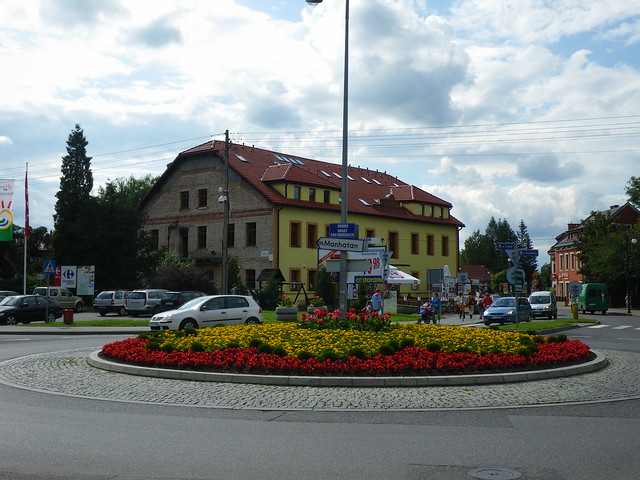
Some municipalities have nearly abandoned the traffic light as a form of managing traffic at intersections. 

Round about


What is the parallel to the round-about in education? Is this completely different than standardization? Should our system have the flexibility to allow more schools to choose different solutions to education?

The PALS program – hope there is more to it than this


This is a video of a teacher sharing an example of the PALS math curriculum in action. The pedagogy in this video though frustrates me though, and although the idea of Peer Assisted Learning Strategies (PALS) seems good, I don’t think the approach this teacher took is very good.

  • She’s using rewards to encourage kids to work with each other. Alfie Kohn does a good job of explaining why this is problematic. "The smiley faces help you remember to mark points." She also spends nearly a minute describing to the kids how to do the task. My experience with kids this young (or any age really) is that they don’t have the attention span to remember something as complex and essentially arbitrary as the instructions necessary to this task "the teacher’s way."
     
  • The students actually have very little interaction in this video with the numbers themselves. The symbols aren’t the numbers. In fact, I think they are an unnecessary layer of abstraction on the concept of number at this young age. Kids need representations of numbers that are more concrete, and once they have a concrete understanding of the concept, then you can move into the abstraction. The entire objective of this lesson seems to be to connect one abstraction (the verbalization of the numbers) with another abstraction (the symbols that represent the numbers).

    If you want kids to learn about these two abstract representations, then you should pair them with a concrete representation with which the kids are more familiar. For example, the symbols should be paired with objects (ie 8 blocks paired with the symbol for 8). You should also teach the two abstractions independently of each other, if at all possible, at least when introducing them.
     

  • It’s clear from the way the kids are reciting facts after this teacher asks questions that they do a lot of this. Reciting something verbatim doesn’t mean you understand what you are doing. In this entire clip, the teacher doesn’t give a single piece of feedback to the students about their learning. Learning is a process through which you incorporate feedback from the world into your existing schema of the world. The only feedback the kids get is the voices of the other children saying the same thing as them, which is minimal at best.
     
  • Not a single kid gets to ask a question, like "why do the numbers look like that?" What would be the harm in the kids spending some time creating their own number system, and then matching it to our existing one?
     
  • It seems like the interaction between the kids is forced. I’m sure there must be more natural ways of discussing the numbers and providing feedback to each other on understanding of the numerals than this contrived activity. 
     

In fairness, I cannot tell from this video anything more than this particular 5 minute segment of this one teacher’s class could use improvement. There does seem to be some evidence that this is a typical 5 minute period, at least at the beginning of class, but it could be that the rest of her class is wonderful. I do think that I wouldn’t share this particular 5 minute clip as example of good pedagogy.

Numeracy for preschoolers

Count 10 Read 10Bon Crowder has started an initiative to embed numeracy in the early lives of children via their parents, which she calls Count 10, Read 10. The basic idea is to split up the 20 minute of reading for parents into 10 minutes of numeracy and 10 minutes of literacy every day. 

Most parents aren’t reading to their kids daily (only about 48% in the US do) which is hurting their abiliy to learn how to read when they get to school. Unfortunately, an even smaller percentage of parents engage in daily numeracy building activies. If you think not being read to impacts your ability to be successful in school, imagine what happens if you can’t count.

Only 45% of adult Canadians are numerate, "demonstrat[ing] skills and knowledge associated with the ability to function well in Canadian society." By comparison, 52% of adult Canadians demonstrate the minimum levels of literacy required for a person to function well in today’s society. Neither of these numbers is very impressive, but clearly our society is doing a slightly better job preparing people to be literate.

The importance of an early start in numeracy has been well established. While the relationship between the ability to do math and being numerate is not completely clear, the relationship between early numeracy and later numeracy should be. Parents can have a strong impact on the numeracy of their children, and should engage in early numeracy building activities.

One issue, besides of course having time to do these activities with their children, is that many parents don’t know many strategies for building numeracy. Just as educators provide strategies for parents to use to develop early literacy skills, we should do the same to help parents with early numeracy strategies for children.

As a parent with a strong sense of numeracy, and an educator, I have some activities I’ve done with my now 4 year son which you are welcome to share with parents.

My son, wife, and I count everything. We count stairs as we climb them, we count plates as put them out on the table, we count down from 10 when we pretend to blast off in our rockets, and up to 10 when we play hide and seek. We count by twos, we count by fives, and we count by tens. We talk about the relative size of numbers, and use language like less than, more than, and other mathematical comparison language.
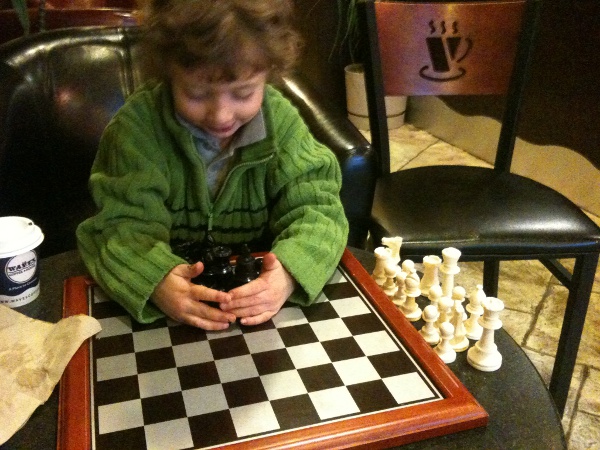
Playing chess

We play dice games, like Backgammon or Parcheesi and recently even more advanced dice rolling games like Titan. My son counts up the two dice by himself to see how far he gets to move, and then counts to move his pieces. We play Chess together, and my son’s favourite part of this game is making up rules for how the pieces can move. We play card games together, like Go Fish and War which not only let my son see both the numerals, and a representation of the number on the cards themselves, but also look for comparisons between numbers.

My son bakes and cooks in the kitchen with both of us and is learning about ratios in food, and fractions in baking. We split cookies into halves when sharing, and cut sandwiches into quarters. We talk about food and how old my son is in terms of fractions. He knows he was once four and a half, then four and three quarters, and now he is four and eleven twelfths. While he doesn’t know what eleven twelfths means yet (although he does understand halves and quarters), the fact he has heard about fractions being used in context allows him to start developing some meaning for them.

We build patterns together. We’ll stack blocks into stair cases. We’ll talk about the shapes of blocks using their names (like pentagon) and together we will explore the similarities and differences between his shapes. We make circles out of his train tracks. One of his favourite toys is his magnetic blocks, which he builds into many different types of shapes.

We also play number games like "How can I get to __?" How this game works is that given a number, you try and figure out different ways to get that number by adding smaller numbers together. For example, 1 + 1 + 1 + 4 = 7. 1 + 2 + 1 + 1 + 2 = 7, and so on. I even recently taught my son how to play Nim, which is a great game for teaching about looking ahead.

The point is, my son is immersed in a world of numbers and his ability to see the world through numbers later in life is greatly increased.

The difference between a question and a quiz

A question is a statement which is asking for the answer to something for which the teacher honestly does not know the answer. A quiz is a statement which assumes that the teacher knows something about the statement, and is checking to see what the person being asked knows. As John Holt suggests, a quiz demonstrates a fundamental distrust between the teacher and their student.

A question leads children to think about possible answers, and a quiz leads children to find either a way to avoid the question, or feel uncomfortable because they aren’t sure for what answer the teacher is looking.

Make sure you ask questions when you want kids to think. If you must quiz students, make sure that they are clear about the purpose of the quiz, and do it in such a way that “I don’t know” is an acceptable answer.

Here are some quizzing techniques to avoid if at all possible:

  • Asking and answering. There’s not much point in asking something if you are just going to turn around and answer it right away.
     
  • Asking that which relies on kids being able to read your mind. This turns kids into guessers.
     
  • Asking that which being able to respond requires that you had to be paying attention moments ago. Turning your quizzes into opportunities to catch kids daydreaming makes kids less likely to want to answer any of them. Everyone loses focus occasionally, find another way to deal with the issue.
     
  • Asking that which is entirely obvious. If you know it is obvious, and the kids know that the answer is obvious, asking about it is just going to make the kids think that you think they are stupid.
     
  • Making rhetorical statements. These aren’t really questions or quizzes but rather a way of presenting information in a confusing way. Your students for whom English is a second language don’t like rhetorical “questions” because they are confusing and useless.

What are some other quizzing techniques we should avoid? (This is a question, since I don’t know the answer, and am actually curious about your thoughts.)

A problem with the problem-solving process

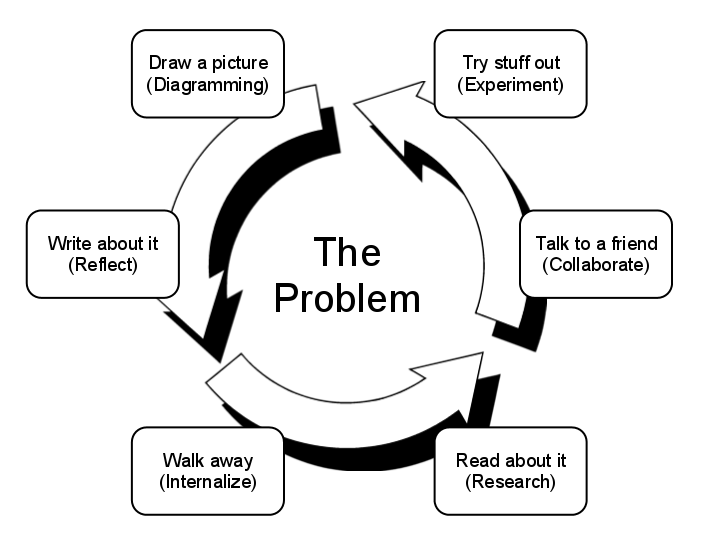
Problem solving in life is rarely a linear process. In fact, when I think about how I solve problems, I find myself using something like the following process.

Problem solving process


Creative Commons Licence


I try out different strategies for solving the problem, but I don’t start with the same strategy all the time, nor do I follow the same steps. Often I’ll skip some of the strategies above, and I very rarely spend the same amount of time working on each step.

The walk-away step I discovered after I finished school. I realized that I would often solve problems at unexpected times, either when my mind was focused in other areas, or unfocused completely. This is not a uncommon occurence, I have read about and talked to many people who note that the solution to problems came to them in similar circumstances.

How do we teach students about the importance of walking away from a perplexing problem sometimes? Can we trust them to walk away but come back to the problem? How do we show them that problem solving is not a linear process? How can we impart the difference between collaborating with someone else on the solution to a problem, and relying on others to solve problems for us?

Math in the real world: Sound

This is another post in my series on math in the real world.

Vi Hart explains much of the mathematics behind noise in great detail, so watch her awesome video below. Thanks to @delta_dc for sharing it with me.


Notice her use of Audacity? I think we could quite easily turn this into a lesson plan… perhaps related to fractions, or to sine and cosine waves.

Multiplication tables in binary

A binary number is a number written in base 2 format, like 101010101111.  The binary number system is handy because it can be easily related to logical operators used in circuitry, and so almost all modern computers use this format for communication.

We use the decimal system for communication in our day to day lives because it is related to our original numbering systems, and this entire system was developed because of we have ten fingers between our two hands. 

To convert a decimal number to a binary number, we want to rewrite the decimal number as a sum of powers of 2. For example, the number 5 is equal to 4 + 1 or 22 + 20 which is the same as 1×22 + 0×21 + 1×20. In binary, we write 5 as 101, since those are the coefficients of the powers of 2 (Try out this application which lets you switch between binary and decimal numbers).

Here is the basic multiplication table for binary, which only includes 0 and 1, since those are the only digits you have to multiply in binary (in a decimal system, you need a much larger multiplication table, since you need to be able to multiply each of 10 different digits, 0 – 9 by each of 10 different digits).


× 0 1
0 0 0
1 0 1


Compare this to the traditional 10 by 10 multiplication table for decimal numbers.

Decimal multiplication table
(Image credit: valilouve)


If you want to multiply numbers in binary, you could use some similar strategies to regular decimal multiplication. For example, 10101 times 101 looks like this:

10101 times 101 = 1101001

If you want to double check, 10101 is the same as 1×24 + 0×23 + 1×22 + 0×21 + 1×20 = 16 + 0 + 4 + 0 + 1 = 21 and 101 is 5 (as we noted before) so this multiplication in decimal is 21×5, which is 105. 1101001 = 1×26 + 1×25 + 0×24 + 1×23 + 0×22 + 0×21 + 1×20 = 64 + 32 + 8 + 1 = 105. See this website for a more detailed example of binary multiplication.

The point of this activity is that you have taken something which is hard to do (memorizing a 10 by 10 times table) and switched it to something which is conceptually more difficult, but easier to memorize. For smaller numbers, it is faster to multiply directly in decimal, but for larger numbers, it will actually take less time to convert them to binary, do the multiplication, and convert back. You may notice that the multiplication step itself is much easier than decimal multiplication, since it’s just a matter of remembering 2 facts (0×0 = 0 and 0×1 = 1) and lining up the numbers correctly so that the place value matches. Check this page out for more information on binary number operations.

If all of this feels arbitrary and bizarre to you, now you know what many 3rd graders feel like when they are first introduced to multiplication.

Group for Canadian educators on LinkedIn

Canadian flag
(Image credit: Christopher Policarpio)

I’ve been using LinkedIn a bit more recently, and thought I should join a couple of groups. I looked for a group for a Canadian Educator group, and found one with a few people who had joined it, but it looked like it was being sponsored by a recruiting agency, and I’d prefer to steer clear of those kinds of groups.

I’ve decided to create a new group for Canadian educators on LinkedIn. Let your Canadian educator friends know about it. I’m not concerned about your job title, just that you are connected to Canadian education. It’s currently in moderated mode, but depending on how it grows, I may open it up completely (I’ve had problems with spam with open groups on other networks).

Find it here:  http://www.linkedin.com/groups?about=&gid=4052478&trk=anet_ug_grppro


How can we create math land?

"If we all learned mathematics in math land, we would all learn mathematics perfectly well." ~ Seymour Papert.


What does math land look like in your classroom? Can we create a space where kids think mathematically, and where the language of the classroom is mathematics?