The Reflective Educator

Education ∪ Math ∪ Technology

Archives (page 84 of 97)

Reflection on using back-channel chat in class

Today we had a joint project in Science and English where students pitched a product they had "invented" which would help solve the global water crisis.  Their product had to be greed inducing and their pitch had to include some of the scientific background required to understand how their product works.

We styled the actual presentation space itself much like the television show Dragon’s Den.  This meant that one person was presenting an idea to 5 students, who had to judge the idea and based on its merits decide whether or not to fund the idea.  This meant that at any time, 5 students were involved in judging and 1 student was presenting.  Unfortunately this left the rest of the audience with nothing to do but watch.

Anyone who has worked with adolescents can tell you that 3 hours (which is how long it took to go through 30 presentations), even if it is broken into two 90 minutes sessions, is a long time for them to hold their interest, especially if they have nothing to do.  Traditionally teachers have often solved this problem by having everyone take the time to evaluate each presentation, which means that students have to be somewhat actively listening in order to do their individual evaluations.  Unfortunately this generally doesn’t work as well as expected given that even this task can be boring and students will often decide on arbitrary marks/comments for their peers, just to make sure the task is completed.

So what we did for this particular set of presentations was set up a back-channel chat for students to use while the presentations were going on.  The idea was, give the students something to do which is engaging and interesting and allows them to express their opinion.  Our instructions were pretty simple,  be respectful and remain on topic.  

The system we used is called "Ajax Chat" and it is an open source web script that we set up on one of our school’s web servers.  This had the advantage of being free, private, and easy to customize.   I made some small customizations before we used the system, for example I first removed the extra menu for users which stopped the students from being able to send private messages, switch channels, and add emoticons to their chat messages.  I kind of felt that all of these would be distractions from actually using the chat.  I also disabled sounds for the chat, as I didn’t want a whole bunch of beeping to  be going on all over the room as each student submitted messages.  Finally I created user accounts for all of the students and sent them individual emails (to do the emails I used Excel + Word + an email merge through Outlook, which was an enormous time-saver) with their unique passwords which I hoped would reduce the number of students logging in as someone else.

At the beginning of the chat, I was pretty lenient about the student’s behaviour because I knew that none of them had used this kind of technology in a school context before, and I wanted to allow them some room to experiment.  After a few minutes of a bit of chat chaos at the beginning, I started asserting control over the chat room and let them know which of their behaviours were inappropriate, and which were good.  When a student went off topic or started spamming the channel, or other types of inappropriate behaviour, I kicked them out of the chat room for 10 minutes, at first with 3 warnings, and then later with 1 warning.  Sometimes the other students would laugh about this, but generally they got it, if you broke a sensible rule using this tool then you wouldn’t be able to use it anymore.  Once the students came back to the chat room, they were better engaged and more respectful.
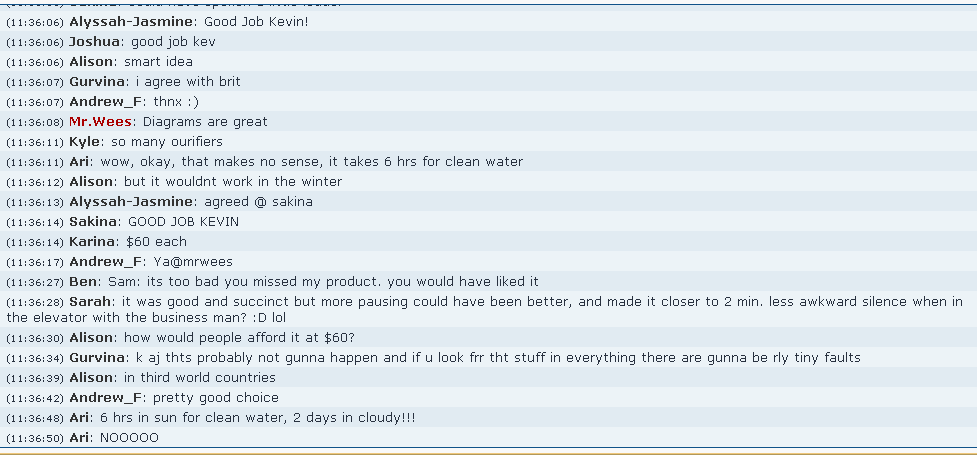
 

You can see from the part of the chat log up top that this was a reasonably successful test of back-channel chat with this group of students. Most of the conversation was on task, perhaps 99% of the comments were focused on the presenters during the entire three hours.  I feel like students really had an opportunity to express themselves, and some students who were normally a bit quieter in the classroom participated more in the chat.

The strengths of the chat room were that it greatly increased the amount of student engagement with the presentations.  I often noticed students asking clarifying questions and checking to make sure that they heard the information given in the presentations correctly.  One student even said, "Wow I learned something new today!" in response to another student’s presentation.  People also were generally good at giving constructive feedback, and recognizing how the students were doing during the presentations.

One of the problems was that as time went on, students would log out of the chat room and not come back. The noise level in the classroom didn’t increase much toward the end of the session, but it was clear that the level of student engagement was lower.  I don’t think that this is unusual for any kind of activity of this length with middle school students, but it does mean that the students who went up first got a lot more feedback about their performances.  That being said, those students got to see a lot more examples of good pitches and model their pitches after previously successful pitches.

I can see why educators have been raving about back-channel chat and am definitely planning on using it in the future, especially for situations where audience feedback is difficult to do and silence is expected, but where it can be so powerful.  I think in a regular classroom setting with a teacher lecturing up at the front, it’s easier for students simply to raise their hands and ask questions,  but in large lecture halls, moderated back-channel chat should most definitely be used.

For people interested in the customizations that made this activity work a bit more effectively, I’ve uploaded the script here (remember that 99.99% of this was created by the very generous programmers at BlueImp.net).  For the technically minded, you’ll need a web server capable of running Php files, and access to a MYSQL database in order to install this web chatting script.
Using Google forms for a “Choose your own adventure” style story

Recently I noticed that Google forms has an option to add multiple pages to a form, and to go to pages based on the responses to multiple choice questions added to each page.  It occurred to me that an immediate use of this would be to construct a "choose your own adventure" story which I always loved reading when I was a student.

The basic idea is, the students construct a story where the next page in the story depends on a decision made by the person reading the story.  Generally in one of these books the reader flips to a different page depending on their decision and so create their own version of the story. With a sufficiently advanced plot, and a long enough book, there can be a very large number of ways a story can unfold.

To recreate this in Google docs, you have to first create a standard Google form.  Navigate to http://docs.google.com and sign in, then click on "Create New" and select "Form".  The title of the form will become the title of their book, and the first large textbook becomes the text of the first page on their book.  Students may find creating a storyboard of their overall story first (including the various links between the pages) will make constructing the overall form easier.  Once they have an idea of how their story will unfold, and what the connections between the pages will be, students should start working on the form.

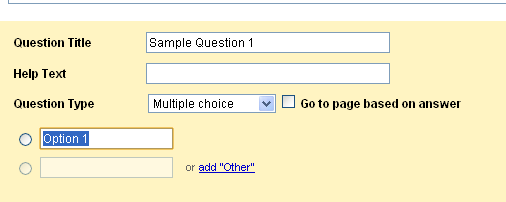
Google Forms - Multiple choiceWhile constructing your form, you are going to alternate between adding page breaks and adding multiple choice questions.  Adding a page break separates the form into multiple pages, and allows you to add a new title for the page and new text for each page.  Each page will also need a multiple choice question, unless the student only wants the reader to move onto the next page.  

The crux of what makes this work is the ability to add pages, and the ability of a multiple choice question to "Go to page based on answer."  In order for this to work, you have to check off this box for each multiple choice question, and link each option of the multiple choice question to the appropriate page (which appears as a drop down next to the option, if you check the box).  Students may find that they need to go back and edit the multiple choice questions, as they may add pages after they have already created the questions, or at least I noticed myself doing this.

The very last page of the form will have a submit button. If after each student has created their form, they share it with their classmates, if their classmates click the submit button, the students will be able to see the final path through their book each of their colleagues used.  They can then have fun discussing their stories with each other, and exploring ways to make their stories better.  Students can also play with the theme of their forms and choose a theme which matches their story.

For a very simple example of what this looks like when it is completed, check this very short and simple story out:

http://spreadsheets.google.com/viewform?hl=en&formkey=dHhSd3hJcy1YVWdYRXNNQWF1NXNfSWc6MQ


Reflection on what Education 3.0 means

What might Education for the Present look like, and how might we best support its proliferation in classrooms?

The first step in turning Education into the present is to use technology effectively. It is possible to track the progress of every child, using effective performance rubrics and know who needs to be targeted with what services, and these technologies aren’t even expensive. Instead of using standardized tests, students could have individualized education plans, which includes shared experiences and personal ownership of the material students are learning.  Rather than trying to drive every  student through the exact same curriculum, students could specialize earlier in their school career and have more choice about what content they want to learn.

What kinds of designed spaces support collective intelligence and how might these be thought of as properly educational?

Google's officesStudents need to be in contact with other people on a regular basis, like all human beings, so the regular school house is not going to be abandoned. However much more space needs to be included in these schools for students to do independent work. The school of the future may end up looking more like the progressive offices of the present.  The design of Google’s offices for their programmers are innovative and interesting, and although they may not exactly look like what you would expect a school to  look like, a lot of the features of their work space are useful for education.

What are the main challenges and risks to integration of collective intelligence tools into schools?

The biggest problem facing education right now is that the people in charge are totally unaware of the damage they cause with their ignorance and suspicion of technology. Without a willingness to experiment and find alternate modes of education, which current political will lacks, education is likely to falter.

What assumptions about learning do we need to give up if we loosen up our understandings of authorship and originality.

Remix culture is huge now, but copyright law has not caught up. Copyright law, in its essence is designed to protect intellectual property by allowing a creator of an idea to profit from their idea. Unfortunately the speed of innovation is greatly slowed down when people cannot collaborate effectively because of copyright concerns. This suggests to me that we need to change the mode of copyright so that collaboration is encouraged, but attribution is secure. The new mode of making money from your ideas will be to offer support, and to create innovative products for your ideas and maximize user interest in your product with creative marketing.

What are the silo structures in the world of education?

To me a Silo structure is a major supporting structure for education. The most important support structure we have in Canada is our provincially funded public schools. This allows all schools to operate at the same level of effectiveness, and is a serious problem with funding elsewhere in the world where municipalities are still funding education.

New social network for Canadian teachers

Just this night I started a new social network for Canadian teachers.  Although there are some national organizations for teachers already, there does not appear to be any free social networks for teachers to join.  There are some regional social networks, for example BC has an Edtech network and Ontario has a social network for teachers from their province.  This new social network is hopefully filling a void in Canada, although it is entirely possible that such a network exists and it is cleverly hidden from my internet searches.

Canadians do not have an educational secretary like the US does.  Education here is divided into provincial and territory regions and each region handles education differently.  There is some oversight from the Federal government, but it is mostly focused on specific issues, and does nothing to connect teachers from across the country.

It is important that educators join together, in large numbers we have a stronger voice.  We also need to be able to communicate with each other because it will help improve our individual practices, and this will be good for our students.  

If you want to join this network, it is free to do so.  All you need is to go to the following website and sign up.

http://canadianteachers.ning.com

Massively collaborative educational research

The book Wikinomics has really got me thinking about how collaboration happens in our society.  One of the area where I think massive collaboration would be really useful, but where it is underutilized is in the area of educational research.  Imagine the power of collaboration that we could have if hundreds of educators collaborated to run a research study.  I’ve written about this before, but I have a new perspective since reading Tapscott and Williams.

Let’s look  at some of the benefits of being involved in such an undertaking.

First, each educator would have their name attached to a valuable piece of educational research.  So much research in education is done with tiny sample sizes that tend to invalidate the purpose of the research.  A large sample size does not guarantee that the research is valid, it still needs to be done with care, but it does tend to reduce things like selection bias, small sample size effect, etc…

Second, we could do research on a wide variety of different socioeconomic backgrounds, different parts of the world, and be able to analyze our data from many different perspectives.  We might even have enough data to spawn multiple educational research papers on our chosen topic.  We could release our data under a Creative Commons license, and let other educators remix and look at the date in different ways.

Finally, the amount of work each educator would have to do would be a lot less.  Designing a study, collecting data, researching sources, analyzing data, and writing an educational research paper are all time-consuming tasks.  Dividing up these tasks over a larger group, even with the additional overhead of maintaining coherence in the research, would greatly reduce how much work each educator would have to do.

If you are interested in participating in such a research study, please sign up at this form.  There is no specific topic or agenda set yet, just an initial examining of the interest from the educational community.


The Role of Immediacy of Feedback in Student Learning

Update: There has been some recent research that suggests that while the timeliness of feedback is one aspect of good feedback, it may not be the most critical aspects of feedback. Awful feedback given immediately is much less useful than carefully constructed feedback given later.


Abstract

A review of the literature on the role of feedback in learning shows that student feedback is critical to student learning.  Although different studies emphasis immediacy in feedback to different degrees, all of the studies reviewed agree that timeliness in feedback is important.

The Role of Immediacy of Feedback in Student Learning

Without feedback of any kind, we would not learn at all, period.  We would end up doomed to repeat the same mistakes over and over again, as the fable of Sisyphus (Camus, A. & O’Brien, 1975) demonstrates.  As teachers then, one of our primary roles for our students is to provide opportunities for feedback, preferably in different forms.  Examining the literature on student feedback, we can see that this claim is supported.

According to Nicol and Macfarlane (2006, p7), there are seven principles of good feedback practice.  Good feedback:

1. helps clarify what good performance is (goals, criteria, expected standards);
2. facilitates the development of self-assessment (reflection) in learning.
3. delivers high quality information to students about their learning;
4. encourages teacher and peer dialogue around learning;
5. encourages positive motivational beliefs and self-esteem;
6. provides opportunities to close the gap between current and desired performance;
7. provides information to teachers that can be used to help shape the teaching.

When Nicol and Macfarlane (2006, p9) clarify these expectations, they indicate that “high quality information” about student learning means “that feedback is provided in a timely manner (close to the act of learning production), that it focuses not just on strengths and weaknesses.”  Quality feedback includes a provision that the feedback is provided close to when the students are learning the material.

Chickering and Gamson (1987, p2) also have seven principles of good practice in practice for education.  They indicate that good practice in undergraduate education:

1. Encourages Student-Faculty Contact
2. Encourages Cooperation
3. Encourages Active Learning
4. Gives Prompt Feedback [emphasis mine]
5. Emphasizes Time on Task
6. Communicates High Expectations
7. Respects Diverse Talents and Ways of Learning

Note that here, Chickering and Gamson have indicated that feedback needs to be prompt to be included in their list of good practice for undergraduate education.  It is fair to assume that good educational practices at an undergraduate level of schooling are also good practices at any level of schooling.

Learners themselves have an understanding of the importance of feedback in learning.  According to a study done on the expectations of students as to levels of support provided by the educational service provider, Choy, McNickle, and Clayton (2009, p8), found that the services found most highly regarded were:

1. clear statements of what I [the learner] was expected to learn
2. helpful feedback from teachers [emphasis mine]
3. requirements for assessment
4. communication with teachers using a variety of ways, for example, email,
5. online chat, face to face
6. timely feedback from teachers [emphasis mine]

Note that feedback from the teachers was listed twice with the qualifiers of helpful and timely.  Clearly the students in this study felt that feedback was important enough to mention twice.

McTighe and O’Connor (2005, p5) reiterate from Wiggins (1998) that “To serve learning, feedback must meet four criteria: It must be timely [emphasis mine], specific, understandable to the receiver, and formed to allow for self-adjustment on the student’s part.”  They have only four requirements for feedback, and the first of these they list is how timely the feedback must be.

One could argue that timely feedback is most critical in student learning.  “[T]imely, detailed feedback provided as near in time as possible to the performance of the assessed behavior is most [emphasis mine] effective in providing motivation and in shaping behavior and mental constructs” (Anderson 2008). Students need the feedback for learning to happen near to the event of learning, according to Anderson (2008), in order to learn effectively, which is what he means by “providing … mental constructs.”

If we view the analogy of learning a physical act, we can see how obvious it is that timely feedback is important.  Although feedback from the learning of sport, or even the act of walking is not necessarily directed by teacher, the very world around us provides us with feedback.  If we fail to walk properly, we fall down!  Kick the ball with your toe, and it is sure to go over the goal.  We learn physical actions very quickly because we receive lots of timely feedback about everyone of our actions.  The only physical actions which are difficult to learn for some people, assuming capability of performing the action, are the ones where the feedback is delayed.

It is clear that any informed educational practice should take into account how feedback will be provided to the students.  Feedback needs to be timely and relevant to the learner’s needs in order to be effective.  Educators must therefore provide assessment opportunities for students with timely and relevant feedback built into the assessments or these assessments are limited in value. 

References

Anderson, T. (2008). “Teaching in an Online Learning Context.” In: Anderson, T. & Elloumi, F. Theory and Practice of Online Learning. Athabasca University.

Camus, A. & O’Brien, J., (1975). The myth of Sisyphus, published by Penguin books

Chickering, A. & Gamson, Z., (1987) Seven principles for good practice in undergraduate education, AAHE bulletin, 39, 3-7

Choy, S.; McNickle, C. & Clayton, B., (2009). Learner expectations and experiences. Student views of support in online learning, National Centre for Vocational Education Research

Higgins, R.; Hartley, P. & Skelton, A., (2002). The conscientious consumer: reconsidering the role of assessment feedback in student learning, Studies in Higher Education, Routledge, 27, 53-64

McTighe, J. & O’Connor, K., (2005), Seven practices for effective learning, Educational Leadership, Association for Supervision and Curriculum Development. 63, 10-17

Nicol, D. & Macfarlane-Dick, D., (2006). Formative assessment and self-regulated learning: A model and seven principles of good feedback practice, Studies in Higher Education, Routledge, 31, 199-218

Wiggins, G., (1998). Educative Assessment. Designing Assessments To Inform and Improve Student Performance. Jossey-Bass Publishers


Professional collaboration and courtesy

Today I got a LOT of work done.  Our school is doing student led conferences soon, which is currently a lot of work for us as teachers because it is only the second time we have run the conferences, and a lot of the preparation work is falling on our shoulders.  Hopefully this will change in the future.  Anyway, the reason I got so much work done is because another one of my colleagues saw me working late at school last night, and when he found out the reason why, he volunteered to cover one of my classes for me today.  So I had an extra 90 minutes to work on grading my assignments, and my students got to practice learning material from their textbooks.  Not an ideal substitute lesson plan, but I did really use the extra time effectively, so I don’t feel too guilty.

It occurred to me that there are a lot of schools where the staff don’t support each other as well as they could.  Some schools have administrators and staff which are downright unprofessional, and everyday I go to work, I’m glad I’m working with fellow professionals.  This kind of give and take is extremely important, not just because it helps us out from time to time but because it establishes a culture of respect and mutual support in the school.

I’ll happily volunteer to co-teach with another teacher when they are planning a technology heavy lesson, or cover someone’s class so they can go to a conference.  I know that they would do the same for me, and by giving each other mutual support, we all win.

If I worked in a school culture which does not accept that teachers need to be flexible and willing to provide support to each other, then I would be extremely unhappy.  I worked in a culture like this a few years ago in NYC, at least at the administrative level, and it was a nightmare.  Although my colleagues tried their best to be totally supportive, they were constrained by a system which had no flexibility, and no creativity provided by our school administrators.

I also met with teachers about different projects we are working on at three different times during the day, for three different issues.  It was really nice to have a quick 5 or 10 minute meeting and just manage to plan and collaborate so easily.  It would be nice if our school day fit more breaks into the schedule so we could meet more often, but I really appreciate working with people for whom working with other teachers comes so easily.  These tiny meetings helped clear up a bunch of potential problems and laid the ground-work for some very exciting projects in the future. 

How are teachers participating in our new collaborative culture?

I’m reading Don Tapscott’s and Anthony Williams’ "Wikinomics: How Mass Collaboration Changes Everything"[1] for the first time, and loving it.  In the book, Tapscott and Williams focus a lot of their examples on the ways businesses are changing rather than on how teachers are adapting.  I thought it would be appropriate to list some ways teachers are participating in the new mass collaboration culture.

First, it’s important to note that as a profession, teachers have always had collaboration, all that has changed is the scale of the collaboration.  Rather than collaboration within a school, teacher’s are now collaborating on a global scale[2][3].  Teachers collaborate to build curriculum, write textbooks, examine student work, build lesson plans, investigate issues related to school improvement, all of this with other like-minded educators from across the planet, all on a scale not seen before.

Collaborative curriculum and textbook writing is changing the way educators gather their resources.  Connexions is "an environment for collaboratively developing, freely sharing, and rapidly publishing scholarly content on the Web." according to their about page.  It is more than that though, because of the way the site is structured[4][5][6].  Anyone can download the publicly accessible textbooks from their site, and can ask permission to join any open projects because the materials are licensed under a Creative Commons attribution license.  The site is very successful with 16141 modules developed as of the writing of this post.  Each module is equivalent to a unit of study in a course, so there already many more modules available than the typical student will ever learn in the course of their lifetime.  Even the state of California has joined in on the action, estimating that they will save taxpayers $350 million by choosing open textbooks.

Teachers have also been forming their own social networks. Classroom 2.0, EduPLN, and other similar regional social networks have sprung up as teachers recognize the value in a diverse set of opinions on education.  Rather than being closeted in the isolation of their individual classrooms, teachers are meeting virtually with other educators in order to improve their practice.  On a weekly basis on the social networking site, Twitter[7], teachers have been chatting on a wide range of topics, using the hashtag #edchat to manage their conversations.  Less formally, teachers are collaborating on the site in smaller groups, and finding interesting uses for the microblogging site in their classrooms[8].

This new form of mass collaboration between teachers is crucial for our survival as a profession, given the rate at which knowledge is growing[9].  Our ability, in small groups or as individuals, to process the information available to us is limited and as a result, we will soon no longer be able to choose the most appropriate curriculum for our students because the amount of information to sift through is too much.  Working on the large scale, in peer groups, we may have a chance to avert this fundamental crisis in education as each member can contribute to the solution, allowing for a much wider range of information to be processed.  Essentially peer collaboration allows teachers to work in networks and increase their individual efficiency, much like networking computers increases their computational power.

References:

1.  Tapscott, D. & Williams, A. (2008). Wikinomics: How mass collaboration changes everything from Portfolio Trade

2.  Riel, M.  (1995). Cross-classroom collaboration in global learning circles, The cultures of computing, Wiley-Blackwell, 1995, 219-242, retrieved from Google books on March 28th, 2010.

3. Zong, G. Developing preservice teachers’ global understanding through computer-mediated communication technology, Teaching and Teacher Education, Elsevier, 2009, 25, 617-625

4. Baker, J.; Thierstein, J.; Fletcher, K.; Kaur, M. & Emmons, J. (2009). Open Textbook Proof-of-Concept via Connexions, The International Review of Research in Open and Distance Learning, 10, retrieved from Google Scholar on March 29, 2009

5. Frydenberg, J.; Matkin, G. & Center, D. (2007). Open textbooks: Why? What? How? When?, William and Flora Hewlett Foundation, retrieved from http://www.uensd.org/NUTN2008/program/Sessions/materials/OpenCouseware_paper.pdf on March 28th, 2010.

6. Hylén, J. (2006). Open educational resources: Opportunities and challenges, Proceedings of Open Education, 49-63, retrieved from http://pascal.iseg.utl.pt/~ssantos/Blog_Recursos_Varios.pdf on March 28th, 2010

7. O’Reilly, T. & Milstein, S. (2009). The Twitter Book O’Reilly Media, Inc., retrieved from Google Books on March 28th, 2010

8. Grosseck, G. & Holotescu, C. (2008). Can we use Twitter for educational activities, 4th International Scientific Conference, eLearning and Software for Education, Bucharest, Romania, retrieved from http://adlunap.ro/eLSE_publications/papers/2008/015.-697.1.Grosseck%20Gabriela-Can%20we%20use.pdf on March 28th, 2010

9. Kurzweil, R. (2001), The Law of Accelerating Returns, published on KurzweilAI.net, retrieved from http://www.kurzweilai.net/articles/art0134.html?printable=1 on March 28th, 2010

What building strong student relationships can do for you


When I first started teaching, I worked at a tough school in Brooklyn called "The School for Legal Studies."  I moved to NYC just before I started working, so I felt lucky to have found an apartment a couple of blocks from the school.  The people I worked with mostly thought I was crazy to live in the same neighbourhood as our school, but to be honest, it really wasn’t that bad of a place to live, except possibly for the hundreds of 6th legged "roommates" with whom I was always at war.  It had some fringe benefits as well.

The most immediate benefit was that I had a very short trip to school.  I could roll out of bed, shower, and throw on some clothes and be at the school in 10 minutes.  This meant I had a bit more spare time available to me and I needed all of it, starting teaching was a very time-consuming task for me.  It also turned out to have another fringe benefit, something that never would have occurred to me.

In the middle of my second summer in NYC, I lost my roommate and realized I was going to need a new place to live.  So I looked around and found another apartment which was still close enough to school that I could walk, but was a lot nicer looking.  I rented a U-haul van and arranged for a buddy of mine from school to come and help me move my stuff.  I parked the truck in front of my house and had just opened up the back to put in a box, when I heard a voice behind me say, "Yo! Mr. Wees, what up son?"

I turned around, and saw 8 of my students standing behind me on the sidewalk.  It wasn’t that unusual for me to run into students from my school in the neighbourhood, many of them lived near the school too.

"Mister, you movin’?  Let us help you," said one of the boys.  10 minutes later, every single one of my boxes and pieces of furniture from my apartment was carefully carried from my apartment and placed gently in the truck.  They wouldn’t let me lift a finger to help them, "We got it Mr. Wees, you lay back," they told me.  The students didn’t ask for a thing for their help, but I gave them some money to buy a couple of pizzas because it was near lunch time.  They wandered off happily, and just after they had left, my friend showed up.

The reason those students helped me was not because they thought they had something to get out of it, but because I had built a strong relationship with them over the previous two years.  They respected me, and saw me as someone who respected them.  We really had nothing in common at all, I was from a small island off the West coast of Canada, they were kids who grew up in the more dangerous parts of Brooklyn.  This didn’t stop me from building a solid rapport with them and I know it was a large part of why I was successful in the classroom.

Participation in school culture

Just recently we had a very different type of auction at our school. Some teachers and many of the 12th grade students auctioned off various services for charity.  For example, one of my colleagues agreed to dress up in drag and take some kids for an ice cream.  Another pair agreed to set up a pizza lunch for the kids.  The funds at the end of the event are going to our global humanitarian fund.

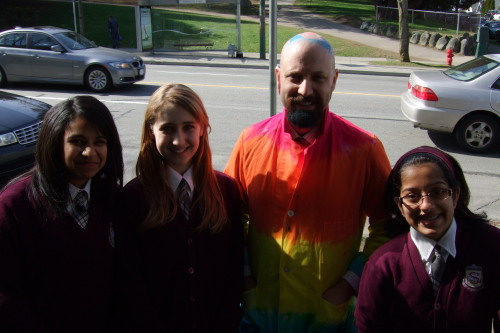
I agreed to have my head shaved, and three 8th grade girls paid for the right to shave my head for $30.  I also had to carry around their books for the day, which ended up being a bit of a logistical nightmare and was abandoned after a couple of periods.

It is important that teachers participate in school culture and at some schools, events like this one just aren’t possible.  If the teachers are unwilling to see that building relationships with the students is crucial to school success, then the school will fail.

Now I’m not saying that every teacher has to shave their head, but some sacrifices might be necessary in order to help your school function.  If we rigidly stick inside what our contracts tell us to do, then a lot of the relationship building crucial to school climate and culture may not happen.  I gave up one of my lunch hours so that these students could create a memory that they will probably have forever.

As they were shaving my head (after some demonstrations and lessons from an experienced head-shaver), one of the girls said, "This was TOTALLY worth $10."  I was thinking the same thing.