Education ∪ Math ∪ Technology

Author: David Wees (page 58 of 98)

The Hidden Danger of Google

Reprinted with permission from my school’s magazine, the Imprint

I watched an interesting, but disturbing, video about a recent phenomena in the online world. You can watch the same video here.

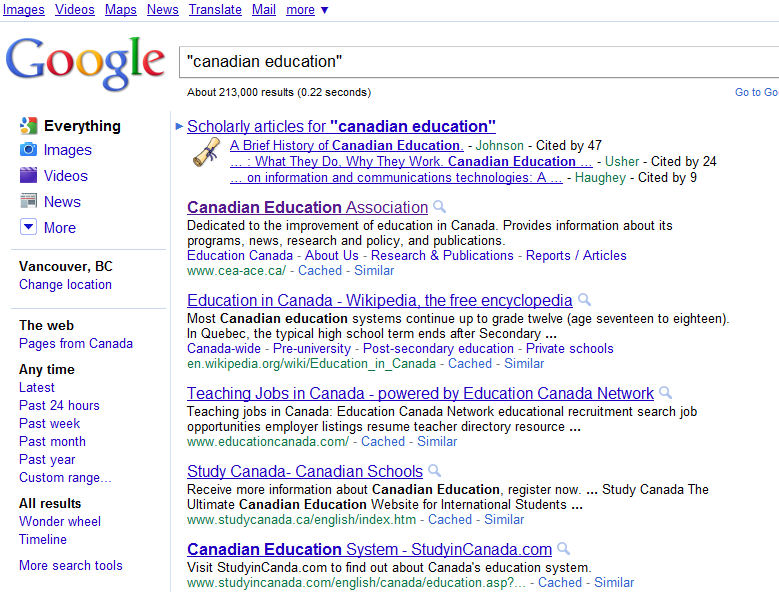
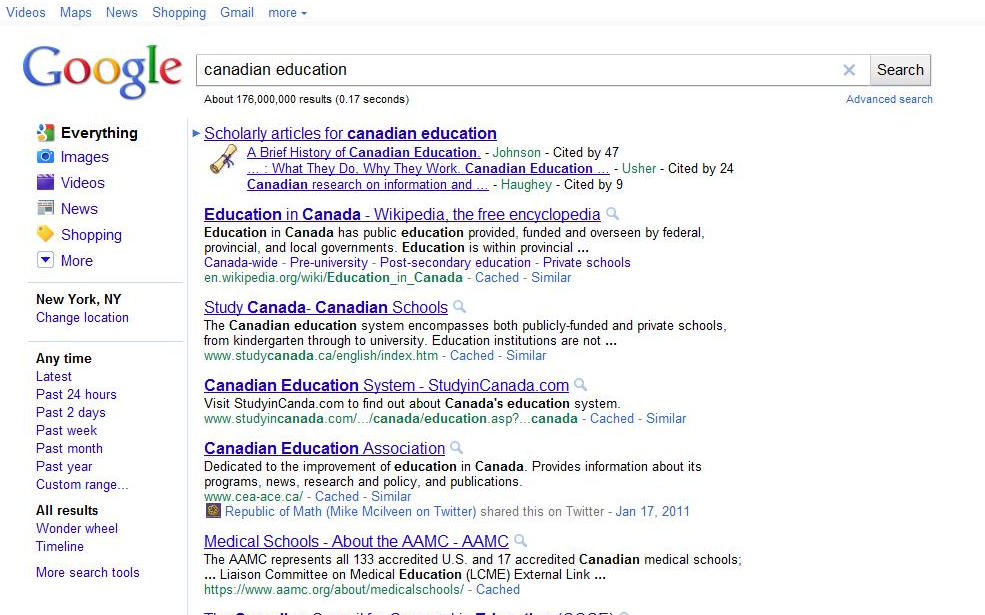
In the video, Eli Pariser makes the point that the recent trend of search engines, like Google (and Facebook) to present information for us based on our past searches and who our friends are, is resulting in our society being divided into “Internet search bubbles.” For example, let’s suppose I do a search on “Canadian education” from inside Canada, and outside Canada. Even an innocuous search like this leads to different results.

In Canada:
Canadian search results

In the United States:
US search for Canadian education

Apparently Google thinks that US citizens who search for Canadian education want to study here, and Canadian citizens want to do research.

What the video points out is that for more politically charged searches, the search results themselves can be radically different, rather than just a bit different, as these two screen-shots show. Two people searching for the same information will be shown very different perspectives. The situation is even worse if you use Facebook to find out about the news, as only news that your friends think is important and which you click on more often will be shown to you.

In the video, Eli describes how he had a good mixture of liberal and conservative friends in his Facebook stream, but he noticed that as he tended to click more on the links in stories of his liberal friends that over time his conservative friends began to disappear from his stream. In other words, Facebook figured out that Eli was a liberal, and decided for him what information would be relevant to him.

What is going on is that Google, Facebook, and other search engines are using a friend recommendation and personal history system to decide what your perspective is, and to deliver you the content that they feel is more relevant to your perspective. This is the same recommendation engine that is part of Netflix. As a result, you are less likely to become exposed to ideas from outside of your friend and family groups. You are now less likely to learn that there are perspectives on the world other than your own.

This speaks to the need to discuss media literacy, as someone who does not know the perspectives of others is less equipped to deal with the challenges of the world. Imagine if you grew up not knowing that there were multiple perspectives on any issue: How would that change your worldview?

While we have always had our worldviews limited by who our friends are, we currently have easy access to resources like newspapers and television to help us find out about alternative perspectives. As television stations and newspapers fail, our students will be facing a world where their primary source of information is filtered. Already more people get their news online than through traditional media, so the failure of television and newspapers is imminent.

The leaders in information literacy at Stratford Hall are aware of this issue, and will introduce students to this issue as we develop their information literacy skills. It is critical that our students know that they are being subtly given a distorted view of the world through their web browsers, and that they must seek out other sources of information.

Regular #BCed chat?

I’m conducting a poll to find out what night would be the best for a regular #BCed chat. Vote below (and see the results). This chat would be open to all interested in chatting about education in British Columbia. I think it would be held about every two weeks at this stage. @MrWejr has volunteered to co-moderate the chat with me. If you are interested in helping moderate the chat, please contact me.

I’ve created a separate wiki to keep track of the chat archives instead of my blog. We will also post suggestions for future topics, and useful information for getting started with Twitter.

Wikipedia & the Magic School bus

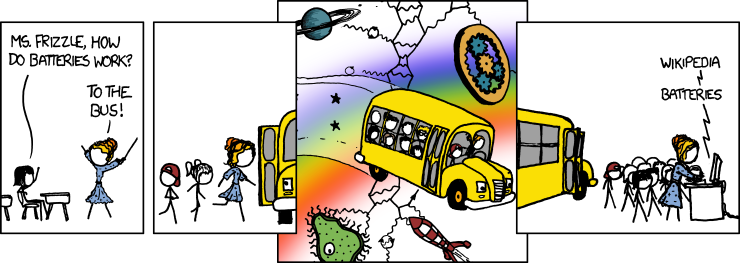
Magic school bus
(Image credit: XKCD)


In many ways this comic from XKCD describes to me the dichotomy between the neo-Liberal 21st century personalized learning model, and the constructivist learning model.

The Magic Bus uses an constructivist approach to learning. In each episode, Ms. Frizzle leads the students through investigations of different scientific ideas through magical field trips. The students lead the process, and Ms. Frizzle uses her questions to draw out their thinking, and to help students decide on the direction of the bus. Often she leads the students through the scientific principles, but she lets them come to their own understanding of the science, while helping to correct their misconceptions.

In the neo-Liberal model, students absorb content through online courses, and the personalization comes in through what pace they are learning the material, and what resources they need to be indoctrinated. One of the primary purposes of technology in this mindset seems to be to reduce the role of the teacher in leading the child through learning, both for a cost-savings effect, but also to reduce the natural tendencies of teachers to indoctrinate children with their own moral values.

Personally, I’d hate to see the Magic School bus model of learning derailed to meet a corporate need for compliant citizens. Videos used to help explain concepts, or as part of a pedagogical approach of individual teachers is okay with me, but as a vehicle for dehumanizing education is entirely inappropriate. If we are going to use technology in our schools, I think it behoves us to recognize both of these arguments for what they are, a fundamentally different approach to education.

Let’s run a greener ISTE conference

Recycle
(Image credit: auntiep)

Last year at ISTE, I saw a lot of waste, and I feel like we should be able to run a greener conference this year. Here are some recommendations.

First, take advantage of the watering stations.  If you are planning on attending ISTE, bring a water bottle (or two). Make sure to fill up your water bottle rather than using the disposable paper cups, or even worse, plastic water bottles. You need to be hydrated, but you don’t need to be producing extra waste. In fact, you could bring your own utensils and a plate as well, and rinse these off in the bathrooms so that you don’t have to throw away paper or plastic plates.

Next, participants, please avoid vendor hand-outs. You aren’t going to look at them. Use your electronic device, and take pictures, or take notes instead. Take the time to get the contact information on the vendors whose products you are really interested in exploring further, and say no thanks to their brochures. Vendors, please learn about QR codes. Provide short urls to resources which are deep-linked if you must, but don’t be fooled into thinking that your little pieces of paper are useful; they aren’t.

ISTE organizers don’t give every participant a copy of the program guide to look at.  Post maps at strategic places within the venue itself, and your already out-of-date schedule, is up already in electronic form on the ISTE conference website.  This is a technology conference, use the technology effectively! Demonstrate best practices.  There were hundreds of laptops with internet connections set up all over the place; these could have been better utilized. Again, nearly every participant will have a portable electronic device with them. Instead of your newspaper, use a blog on the website with an RSS feed.

Everyone at the conference should put their devices to sleep when not in use. The power output at ISTE will be enormous, and given that in the United States some of this power comes from coal, it behoves those of us involved to be aware of our power use. The ISTE laptops, while useful, should go to sleep, with instructions beside each one available so that people know they can wake them up from hibernation mode and use them. The LCD projectors that nearly every vendor feels like they need to use are expensive in terms of power use. Vendors, your products aren’t more likely to sell because you have a flashy presentation, they  will sell if they are useful.

What are some other things we can do to run a greener conference?


Do you feel respected?

Here are the results from a simple poll I posted through Twitter.

Do you feel respect poll?

A flaw with this poll is that I’ve not defined community, so respondents were free to decide if this meant their local school community, or the community in which their school is located.

The results speak for themselves though. A profession which dedicates itself to long hours and relatively low pay (when compared to other professions where a Masters degree is nearly mandatory) should receive more respect than this.

The good news? Many teachers do feel respected in their community, myself included.

Must reads for new teachers?

One of my grade 11 students wants to be a mathematics teacher. She has asked me a for a list of books she should read. Here is a list of books I would recommend, along with some recommendations from members of my Twitter network.

What else would you add to this list?

Lemonade stand

Lemonade stand

I saw some little kids and their parents at a lemonade stand on Sunday, and I thought to myself, "how cute!" I found out that the proceeds from the lemonade stand were going to be used to help fund sports equipment and other necessary supplies at a local elementary school, and I thought to myself, "how sad."

Wouldn’t it be nice to live in a world where lemonade stands were set up by kids for "extra money"? Shouldn’t we fund education sufficiently so that first graders can worry about other things?

Derek Stolp on “A Mathematician’s Lament”

I recently contacted Derek Stolp, author of Mathematics Miseducation: The Case Against a Tired Tradition and shared with him Paul Lockhart’s essay entitled "A Mathematician’s Lament." With his permission, I’m sharing his thoughts below.

Lockhart’s argument is very compelling, and I certainly share his concerns about the state of mathematics education in this country, if not the world! The traditional approach to teaching mathematics, however, is only part of a much larger problem: the widespread acceptance of the transmission model of learning (as opposed to the constructivist model). Educational practices continue to be dominated by the principle that, if I may state it baldly, children just need to be told what to know and how to think, and this is true to some extent in nearly every academic discipline. (And I believe that this authoritarian model is, in the long run, inimical to the development of democratic values and practices!) I won’t belabor these points here but I do discuss constructivism and the tool metaphor on about pages 50 – 60 in my chapter entitled “Whose Knowledge Is It?”

Despite the power of Lockhart’s argument, I do think he needs to go beyond a lamentation. When I wrote my own book, Mathematics Miseducation, my wife read the opening chapter and said that she found it to be too negative. (As a kindergarten teacher, her preference is for the positive approach.) I told her that, as a math teacher, my habit is to identify the problem and to be certain I understand its contours before trying to solve it. In subsequent sections of the book, I do try to present possible solutions that solve the problem. But the book itself does not provide enough detail for the average teacher to change her/his practice so I decided to set up a web-site with lessons that teachers could use that would be consistent with my approach. I’m not entirely happy with all of the contents of that site – I’ve had to compromise my ideals with the practical reality of the school in which I teach. My 8th graders go on to secondary schools so I have to teach them algebraic fractions and radical expressions in my algebra course, as distasteful as it is to do so. And when they ask me, “Why do we have to learn this?” I try to be honest and say something to the effect, “If it were up to me, I wouldn’t teach these things. Math education is very slow to change, and it’s stuck on 19th century practices. But you’re going on to a school that will require you to learn these things, so I’m trying to get you started in a way that will diminish the pain for you next year.” 

Here’s another example of a compromise I’ve had to make: About 15 years ago, when I was chairman of the math department at Milton Academy in Massachusetts, some of my colleagues and I introduced mathematical modeling courses as alternatives to traditional symbol-manipulating abstract pre-calculus and calculus courses. We taught the same fields of concepts – in trigonometry, for example, modeling studied the rotation of a Ferris wheel and the shifting of tides whereas the traditional course found it more important to develop all those unnecessary trig identities – but at the end of the year, we devoted three weeks to SAT Math Level II review because these kids and their parents, while they loved the course, were not about to sacrifice their standardized test scores.

So here’s my point: Dr. Lockhart has, in his paper, identified the problem very clearly. His next step is to offer an alternative that will remain true to his ideals but that will realistically fit in a more traditional environment. He does suggest a way:

“So how do we teach our students to do mathematics? By choosing engaging and natural problems suitable to their tastes, personalities, and level of experience. By giving them time to make discoveries and formulate conjectures. By helping them to refine their arguments and creating an atmosphere of healthy and vibrant mathematical criticism. By being flexible and open to sudden changes in direction to which their curiosity may lead. In short, by having an honest intellectual relationship with our students and our subject.”

But how could he be more specific for those teachers who are sympathetic to his arguments but need guidance and resources? One way he could do that is to create a web-site with problems he has posed, indicating the levels at which they are appropriate. He’s been teaching high school, I gather, so he must be developing some materials. (I would love to see the day when textbook publishers are out of business because real teachers put their materials on-line for other teachers to access for free.) This, of course, will require considerable compromise on his part, compromise that he might feel destroys his objective. But I see no alternative.

The reality is that our schools are captive to an authoritarian trend to top-down standardization, and neither political party believes in a democratic form of education – Arnie Duncan has merely put old wine in new bottles – because we don’t really have a progressive political party – just a Republican Party and a Republican Lite Party. Progressives in education will have to chip away at the edges a little at a time and that will require distasteful compromises.

I’ve been asked to look at the Upper Elementary (Grades 4 – 6) math program at our school, and I’ve recommended using a program called Everyday Math. While I am not a textbook fan and haven’t used any for more than fifteen years, these teachers are teaching every subject and they need a resource. Here are excerpts from my memo to them:

"I know that it’s normal for every teacher to think about what needs to be accomplished by the end of the year so that his/her students will be ready for the next level and, since the kids are coming up to middle school, I thought I should let you know what skills, habits, and understandings I’d love to see among the incoming children. At http://www.maa.org/devlin/LockhartsLament.pdf is a paper entitled A Mathematician’s Lament which has been expanded into a book. This article was sent to me just this week from a math teacher in Vancouver and, while you’re certainly welcome to read the whole thing, I’d encourage you to read at least the first two or three pages – it will give you a flavor for the author’s point of view and, since I agree with him in principle, mine as well. His goals are lofty if unrealistic in today’s educational context, but they are certainly worth keeping in the back of one’s mind.

So, here are some of the important qualities that I would hope each child would possess coming into the middle school:

– Enjoys doing math
– Feels confident about approaching new problems
– Likes to make conjectures about patterns and is comfortable about being wrong
– Can talk about methods of solution with classmates
– Is resourceful about finding a solution method if he/she had learned it before and has forgotten it.

You’ll notice that there’s nothing here about knowing his/her times tables or knowing how to add fractions. Naturally, I’d love for each child to know these things but, to me, they are secondary. If a child has to take timed quizzes on multiplication facts (mad minutes?) or do pages of drills on adding fractions to master these, then the price is too high because it hampers the development of the qualities that I believe to be more important. So, that’s my bias. In the process of teaching math, we want to expose them to the many concepts and skills in your curriculum but, if they aren’t ready to master some of them, that’s fine – they’ll master them later.

One thing to keep in mind about the program: it’s not important for each and every child to achieve mastery before moving on. Some will, some won’t, and those who won’t will have chances later on to achieve it. And if they don’t by the seventh grade, don’t worry about it – I’ll address it then, and maybe they still won’t achieve mastery. (Several years ago, I had a conversation with a parent at Milton who was also a child psychologist working at MIT’s Department of Brain and Cognitive Sciences and she told me that several of her colleagues used to joke about the fact that they had never been able to learn their times tables. Somehow, these people managed to get by!!) The program has a good balance between skills practice and review on the one hand, and investigations and games, on the other. And I would lean heavily in the direction of investigations and games."

This memo to my colleagues reflects the kinds of compromises that I believe are necessary; the road to progressive education can be walked only one step at a time. Anyway, these are my thoughts regarding Dr. Lockhart’s excellent article, and thanks for allowing me to share them with you.

Derek Stolp

A Mathematician’s Lament – The online book study

Is this mathematics?

Math worksheet 

Join us this coming Thursday, at noon Pacific time, Richard DeMerchant, and I will be hosting an online book study of "A Mathematician’s Lament" which is an absolute must read for all mathematics educators. One of the questions we will try to answer is the one above, and you can ask more questions either on this blog post, or on Richard’s original announcement

‘I don’t see how it’s doing society any good to have its members walking around with vague memories of algebraic formulas and geometric diagrams, and clear memories of hating them.’ (emphasis mine) ~ Paul Lockhart, A Mathematician’s Lament, p33

Paul Lockhart, first in his essay, and then in the extended version of his argument in his book, makes the case that current practices in mathematics education are fundamentally flawed because students spend much time learning the language of mathematics, without ever getting to actually do mathematics. I recommend reading his work in full, even if you are unable to participate in the upcoming book study.

Our plan is to work through his book and discuss the ideas in it, using quotes from the book as ways to kick-start conversation. Here’s my favourite quote from his book. What do you think of it?

‘Everyone knows that something is wrong. The politicians say, “We need higher standards.” The schools say, “We need more money and equipment.” Educators say one thing, and teachers say another. They are all wrong. The only people who understand what is going on are the ones most often blamed and least often heard: the students. They say, “Math class is stupid and boring,” and they are right.’ ~ Paul Lockhart, A Mathematician’s Lament, p21