This is another post in my series of posts on math in the real world.
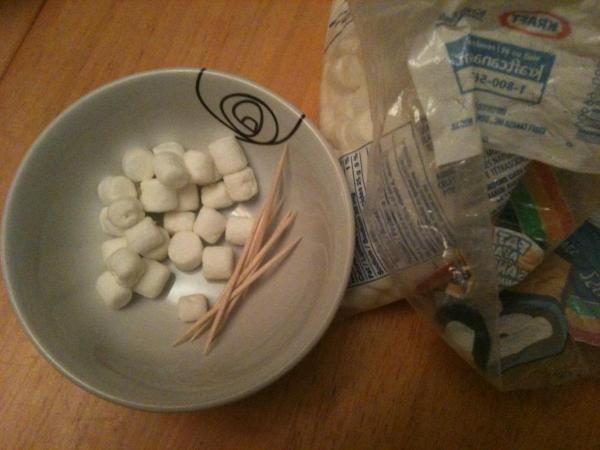
My wife, son, and I went to a kids science event at SFU today, and at one table they had some marshmallow diagrams set up to demonstrate molecules. They let the kids play with the marshmallows and toothpicks, so my son made a giraffe. When we got home, he helped himself to some marshmallows and toothpicks and continued to make things with them.
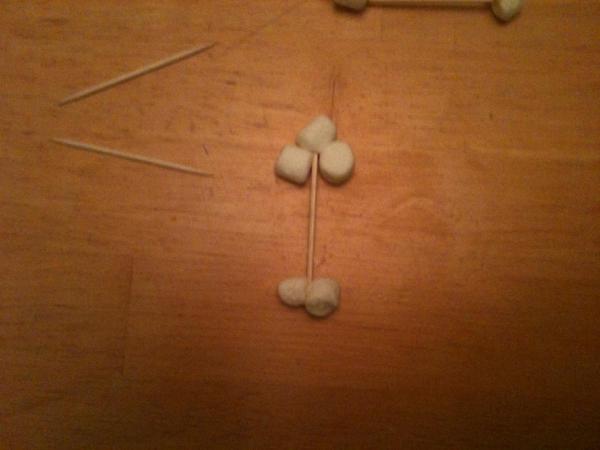
My son noticed that the most stable form included triangles (with some help from mommy), so he started to construct everything with triangles. When he moved into three dimensions, he noticed that the tetrahedron was the most stable of the forms he could build and so his construction soon began to look very mathematical in shape.
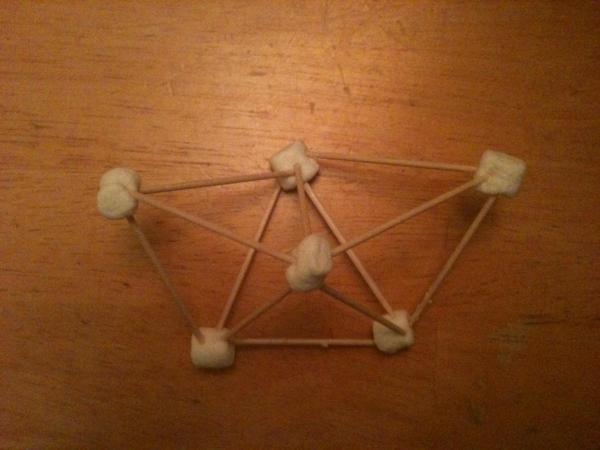
Now in his most complex form, he has started to build a three dimension tesselation. If he hadn’t been called away to dinner, or if we hadn’t been running low on toothpicks, I’m sure he would have continued the pattern.
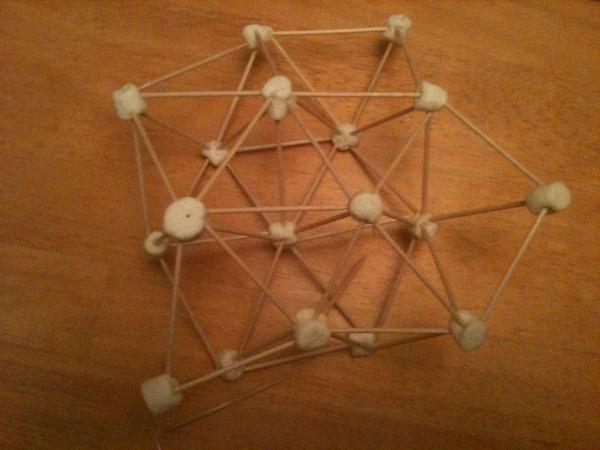
This activity involves both 2d and 3d geometry, tesselations, sequences and other patterns. Can you think of other mathematics that can be found in this activity?

John at TestSoup says:
I remember doing something similar in physics class with glue instead. We tried to make the lightest bridge that could support the most weight.
October 31, 2011 — 1:37 pm
David Wees says:
Yeah, I remember doing a bridge activity when I was in school. It was a lot of fun. I still have some feelings of guilt over it though as well. When we worked on it in school, I "took over" the project and another student called me out and told me that she really wanted to be able to work on it too. Sigh, still feeling guilt about it 20 years later, so I think that was a lesson learned.
October 31, 2011 — 2:04 pm
Haley O'Connor says:
I brought many, many toothpicks and marshmallows to school last year when my grade 4/5 class was learning about 3d objects. We build cubes and pyramids together, and then just explored to see how many different kinds of shapes we could make. In the end, we had dozens of different 3d shapes including many we couldn’t name. An excited group of students spent a lunch hour huddled around laptops, searching the internet for shapes with a certain number of vertices and faces so that they could put names to the shapes they had created. 🙂
November 5, 2011 — 2:28 pm