Now that I’ve been coaching math teachers again, I have been in a lot more classrooms and doing classroom observations again.
In a past iteration as a math coach1 , I created this checklist of things2 to look for explicitly when observing teachers. The goal at the time was to be able to have our team have a clear list of observable behaviours so that we could measure whether our professional learning work was landing with teachers. With 8 instructional coaches and 30 schools in our project, we needed something that would work at scale.
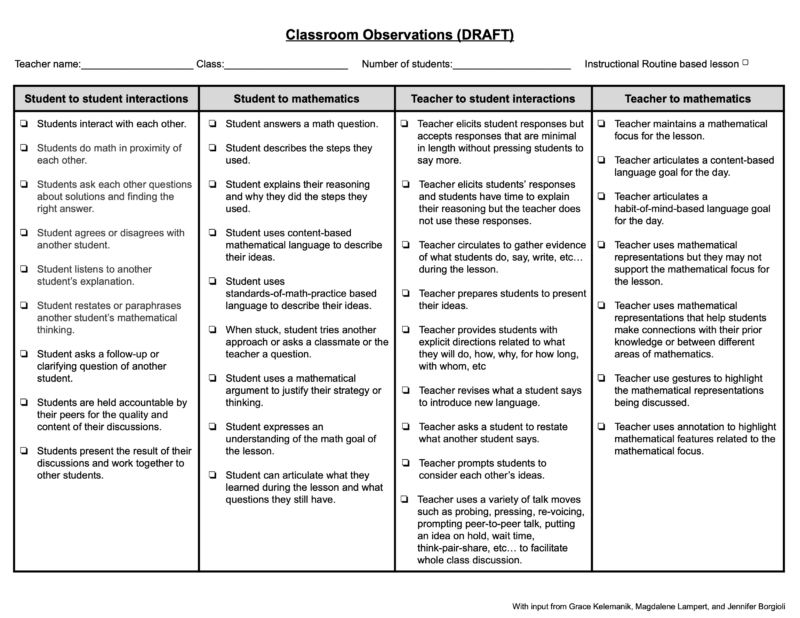
We created curricular resources for teachers, ran workshops for teachers to teach them how to use the curricular resources (via modeling, rehearsals, and dialogue), and then coached the teacher leads at the schools. We would then observe teachers in their classrooms and teacher leads in their meetings, so that we could learn whether our work was landing. Over time, we iterated and improved our approach as we learned from what we did.
As an individual coach though, my goals for lesson observations are tied to the coaching work I do with teachers. The teacher I’m coaching and I decide together what I should focus on when observing them, and I spend much more time learning alongside the teacher instead of just sitting back and passively observing their classrooms.
I’ve since been heavily influenced by Elham Kazemi’s (et al.3) Learning Together so that instead of trying to transmit what I know to the teachers I work with, I work with teachers to try out different strategies to see what works with these students in this context, focused heavily on instructional goals informed by our conversations, data we have collected, and the goals of the school. I still do typical coaching ‘moves’ such as modeling instruction, observations, and leading team meetings, but these are in service of our shared learning.
Neither of these approaches are better than the other. They are meant to serve different types of structures and sets of resources available. But both are meant to serve the main goal — the learning of teachers in service of student learning. One’s strategy for coaching should match the available resources one has and the goals one has for that coaching.
I like Graham Nuthall’s definition of learning as ‘long-term changes in what learners know, believe, and can do.’ From this definition, we can see that one cannot directly observe student or teacher learning from a single lesson observation; all one can observe in learners are behaviours that are likely to lead to learning. Lesson observations therefore also have to be paired with collection of other kinds of data, including student performance data collected over the long term, and data about changes in teacher practice that are sustained.
Either approach therefore will require a longer term view. It’s hard to see if long term changes are making an impact as well, as one needs both a control year (how much did students change this year) and a treatment year (under this new strategy, how much did students change). You also need time to see if the strategies you and teachers learn stick, since you are learners too! My recommendation is to make sure to study the impact of your work and repeatedly iterate on both your coaching approach and the teaching strategies your team tries, until you see the results you want.