When many people think of science, they think of the tools of science, much like the photo of a traditional science lab above shows. They think of beakers, and hypotheses, and labs, and think that this is science. Playing with the tools of scientists does not make one a scientist, or become a scientist. Thinking like a scientist does.
Science is a way of thinking, a way of reasoning about the world. People who reject science, reject reason. Science is not a linear process, it is a dynamic way of thinking and collaborating about the world.
There are flaws with this way of thinking, as there are with all ways of knowing. Science cannot answer ethical questions. Scientific results get fabricated, exaggerated, and misunderstood all the time, since they are produced and understood by human beings. However, the process of reproducing results with additional experiments ensures that, over time, bad ideas get weeded out of what we know to be true about the world. Ideas which are correct get re-inforced by additional experiments.
Teaching science as a series of facts someone else has discovered about the world does not give them the opportunity to learn about the process through which those "facts" were discovered. The process, in this case, is far more important than the result. Our schools need to spend far more time dealing the messiness of the process of science, and less time focusing on the results of the scientific process. Students learn process through practicing it.
We also need to recognize that the standard science lab write-up emphasizes a linear process of science, which does not exist anywhere in the scientific community. Following someone else’s lab to learn how to use the tools of science is fine, but one must actually design experiments for oneself in order to learn the process. We need to de-sitcom science education.
It occured to me today that schools spend an enormous amount of effort to ensure that they are free of toxins for students. We ban common allergens from the school that are life-threatening for some students (like peanuts) and we build our schools so they do not contain asbestos insulation or lead pipes. Some schools are very concerned about the effects of wifi on students, and so have banned wifi from their schools. When we have a belief as a community that something is toxic for our students, schools rally to protect students from that toxin.
So why are so many schools toxic places for LGBTQ youth?
Obviously many schools have made an effort to develop cultures which are supportive of all of their students, but there are places where physical toxins are banned, and emotional ones are encouraged and even nurtured.
Interview from 1996 World Conference on Literacy, organized by the International Literacy Institute, Philadelphia, USA.
I watched this interview of Paulo Freire, and I thought what he had to share is so important that I took the time to transcribe the interview, which you can read below.
A conversation with Paulo Freire
"If you ask me Paulo, what is in being in the world, that calls your own attention to you? I would say to you that I am a curious being, I have been a curious being, but in a certain moment of the process of being curious, in order to understand the others, I discover that I have to create in myself a certain virtue, without which it is difficult for me to understand the others; the virtue of tolerence.
It is through the exercise of tolerance that I discover the rich possibility of doing things and learning different things with different people. Being tolerant is not a question of being naive. On the contrary, it is a duty to be tolerant, an ethical duty, an historical duty, a political duty but it does not demand that I lose my personality.
On a critical way of thinking
Even so it is for me, it should be a great honor to be understood as a specialist in literacy. I have to say, no because my main preoccupation since I started working 45 years ago had to do with the critical understanding of education. Of course, thinking of education in general, I also had to think about literacy which is a fundamental chapter of education as a whole.
Nevertheless, I also had strong experiences in this chapter of adult literacy, for example, in Brasil and outside of Brasil. The more I think about what I did and what I proposed the more I understand myself as a thinker and a kind of epistimologist proposing a critical way of thinking and a critical way of knowing to the teachers in order for them to work differently with the students.
On language and power
Who says that this accent or this way of thinking is the cultivated one? If there is one which is cultivated is because there is another which is not. Do you see, it’s impossible to think of language without thinking of ideology and power? I defended the duty of the teachers to teach the cultivated pattern and I defended the rights of the kids or of the adults to learn the dominant pattern. But, it is necessary in being a democratic and tolerant teacher, it is necessary to explain, to make clear to the kids or the adults that their way of speaking is as beautiful as our way of speaking. Second, that they have the right to speak like this. Third, nevertheless, they need to learn the so-called dominant syntax for different reasons. That is, the more the oppressed, the poor people, grasp the dominant syntax, the more they can articulate their voices and their speech in the struggle against injustice.
In the last moments of my life
I am now almost 75 years old, sometimes when I am speaking like right now, I am listening to Paulo Freire 40 years ago. Maybe you could ask me, but Paulo, look then you think you did not change? No, I change a lot, I change everyday but in changing, I did not change, nevertheless some of the central nucleus of my thought. The understanding of my own presence in the reality. How for example, could I change the knowledge or the experience which makes me know that I am curious? No, I was a curious boy, and I am a curious old man. That is, my curiousity never stops. Maybe in the last moments of my life, I will be curious to know what it means to die.
My philosophical conviction is that we did not come to keep the world as it is. We came into the world in order to remake the world. We have to change it." Paulo Freire (1921 – 1997)
Of course, Paulo’s arguments on language and power can be adapted to not just apply to the indigenous people to whom he was referring, but to any group without power. Teach your students that words have power, and that you respect their words, whatever their source, but to learn the "dominant" culture’s words is to empower yourself, and to give yourself a voice.
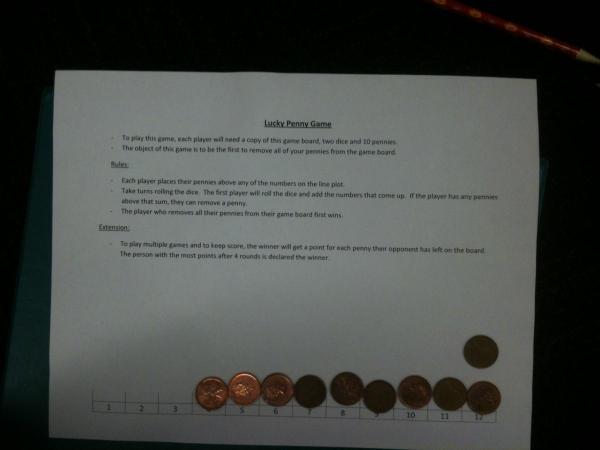
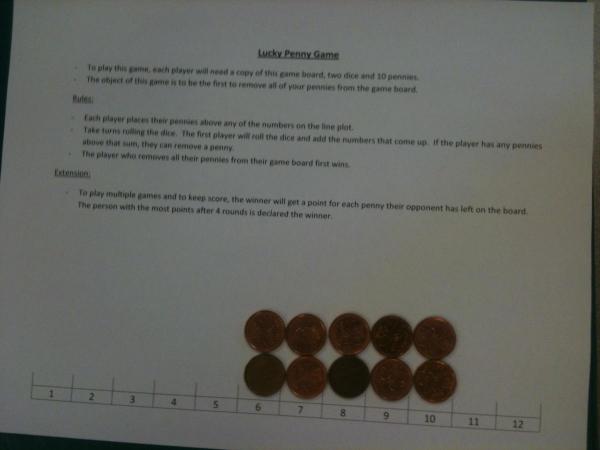
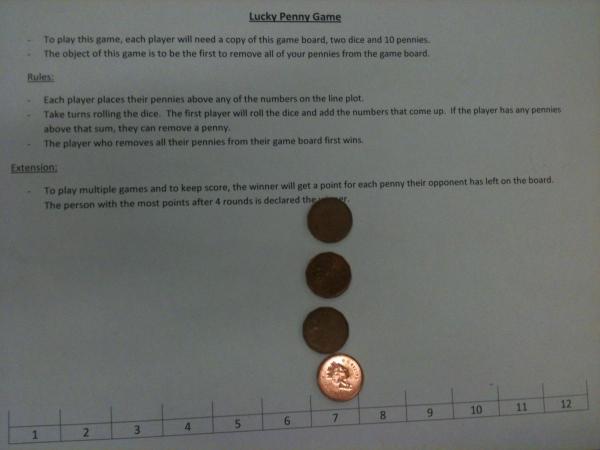
My colleague found an activity to do with his 5th grade class, similar to this one. Basically, he gave the students 10 coins each, and asked them to put the 10 coins on a number line (with numbers from 1 to 12) with a partner. Each round they roll 2 six-sided dice, find the total, and remove a coin from their number line if it matches the roll. They keep going until one of the two students has no coins on the number line.
At first, most student’s starting positions looked like this:
or this:
At the end of the lesson, we played a 5 coin version of the game, and one student’s paper (after 1 round) looked like this:
Unfortunately, although most of the students did notice that some numbers came up more frequently than others, as evident by their distributions looking a bit less flat, and bit more centred on 7 on the number line, many of the students still had obvious misconceptions of probabilty. Students made comments like:
"If I spin around twice before rolling, I get a more lucky roll."
"I got a few 11s last game, so I’m going to put a few more coins on 11."
"8 is my lucky number! I’m going to put 3 coins on 8."
"I need to spread out my numbers so I have more chance of getting a coin taken on each roll."
Our plan for next class is to have students switch up groups, discuss insights they’ve had on the game, play a couple of rounds, switch them up again, while we walk around and see what strategies they use. Hopefully we’ll see less students spinning around in order to improve their dice luck…
I also asked for resources on Twitter for using a probability game as part of a lesson on probability, and had the following 5 games recommended (all of these look good because they are relatively easily produced and used in an elementary school classroom).
I wrote a simulation to test to see what distribution of coins is the best. I am somewhat surprised by the results. Check it out here.
Why am I surprised by the results? My intuition about how this game works failed me. I thought that the likelihood of each number coming up was the most important factor in deciding a good strategy for the game. It turns out that one has to balance out the knowledge of the likelihood of each number being rolled with having a selection of numbers available. It may be that the probability of a 7 being rolled is 6/36 but the probability of a 6 or a 7 being rolled is 11/36.
In fact, it turns out that having a selection of different rolls available is fairly important. I updated the simulation so I could choose the number of coins to place, and with 3 coins placed, choosing 4, 5, 6 is better than having all three coins on the number 7. With 2 coins, it is better to choose 6 and 8 than to put both of the coins on 7 (although 6, 7 is better than 6, 8 – but only slightly).
There are three messages I get from running this simulation.
One should, in general, not make too many intuitive assumptions about how probability works, particularly with somewhat complicated examples.
One should be careful how one uses even simple games to teach probability. All of the students saw that 7 was the most common number, but their intuition of "choosing a wide spread" is a valuable one for this game, but it doesn’t help us get at the idea of some numbers being more likely than others. I think we’d need a different game for that.
It is probably a good idea to build the simulation before you play the game with students, if at all possible.
I noticed through this blog, that the CBC had published the PISA results for Manitoba (released as charts) for 2000, 2003, 2006, and 2009. I wanted to verify the results they had posted, especially the mathematics data, so I went and looked up the data for myself on the Stats Canada website (which you can access yourself here, here, here, and here). Using this data, I created th graph below, which shows the scores in math for Canada and for each province (get the raw data here).
I’m not sure what this data shows, although I can see some trends. Of course, if I change the scale, the overall trend seems more clear.
It looks to me like overall the results have been somewhat stable, at least at this scale. While the trend in Manitoba definitely looks like a downward turn for the last few years, and this trend is probably statistically significant, overall for Canada, it looks like the results have moved somewhat randomly, as one would expect from year to year.
Not convinced that there are cultural nuances in how we understand and define math? Watch the following short video (see http://www.culturecognition.com/ for the source) in which a child explains the number system his culture uses to another child.
There are other areas in which we understand mathematical concepts differently depending on our culture. For example, this recent study suggests that something like ‘numbers come in a certain order’ may be a cultural representation, and not one of which most of us are aware.
One wonders, if we can see such dramatic differences between different cultures in terms of understanding something fundamental like number, how likely is it that there are other differences within our own culture?
My wife, for example, tends to rely on landmarks for navigation, but I tend to rely on an internal map based on the names and numbers of the roads. She and I therefore have a different understanding of how one should navigate. I can remember meeting people who could not read a map (but who were otherwise able to navigate with ease) suggesting that our representations of geographical information may differ greatly between different people.
Yesterday, I was covering a colleague’s math class at the last minute, and he had made photocopies of a chapter 1 to 7 review. I looked at the review sheets, and the grade 10 students in front of me, and decided that it was unlikely that the review sheets were going to be useful. I handed them out, and then started putting puzzles up on the board.
The first puzzle I put up was the Seven Bridges of Königsberg problem. Within a couple of minutes, every student was trying to figure out the path across the 7 bridges that doesn’t cross any of the bridges more than once. Before the students got completely frustrated with this problem (since it is deceptively simple to state, but "difficult" to solve), I put up a couple more problems, including a gem from Dr. Gordon Hamilton. I added the frog hopping problem to the board, and taught two students the game of Nim.
Each problem had some students who were working on it intensely. Every student found some problem which was interesting to them, and almost all students were working in small groups on the problems and puzzles. Eventually, a small group of students gave up on all of the puzzles and worked on the review sheets while the rest of the students continued to work on the puzzles until the end of class.
Some students asked for a hint on the bridge problem, and I led them (through questioning) to Euler’s formulation of graph theory. From this, we discussed that there could be at most one starting spot, and one ending spot, and that only a starting and ending spot could have an odd number of paths leading in and out of it. I then put up the 5 rooms puzzle, which one of the girls said within seconds was unsolveable by applying Euler’s analysis to the graph.
A group of boys worked on the frog problem, and went from struggling to even find a single solution to the 3 frog problem to being able to generalize a solution for n-frogs on either side (and a formula for determining the number of moves for each frog puzzle).
The next day, I spoke to my colleague, and asked him if he was okay that I had not done the worksheet with the students. As expected, he was fine with it. I asked him what the students said. He said that students said that they enjoyed the day before, but one student had said, "We didn’t even do any math yesterday."
I’m not sure I agree with that student, and I’m slightly distressed that he didn’t see the problem solving activities we did as being part of math. What do you think? Are problems like these important in mathematics? If so, why aren’t more of them in our curriculum?
I just found this presentation from more than a year ago on some interesting ways to use Google Apps in a mathematics classroom. I noticed that it had been edited slightly, so I did some more edits and thought I would share it here.
You can help edit and curate it here. I could imagine that Google+ would be useful, and that some of the file sharing options through Google Drive have improved, neither of which has made it into this presentation yet.
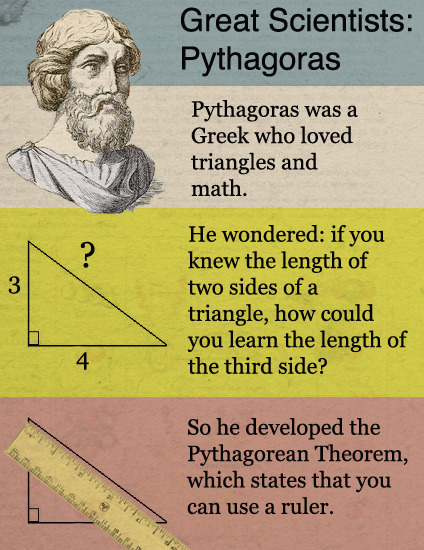
The problem is, there is a kernel of truth in this satirical comic. Given most problems we will encounter in life, we would use a ruler to find the third side of a triangle. Obviously I think that there are good reasons to learn the Pythagorean theorem, but for most real life applications, one could draw a careful scale diagram (an incredibly useful skill in itself) and apply ratios to your measurements of your diagrams to find the missing length.
So why do we teach the Pythagorean theorem? Is it because of the power this abstract idea has? Are there other abstract ideas which have equal value? Could you imagine a mathematics curriculum which includes lots of rich abstract ideas, but happens to not include this theorem? How important is this theorem anyway?
Derek Muller has done research on the effectiveness of science videos. To summarize his research in brief – when you present only the correct information in a science video without the possible misconceptions that students may have, students learn less (but feel better about the experience) than if you present information in a science video and include the misconceptions.
Of course, we should recognize that this effect probably does not depend on the medium of instruction, only on the nature of the medium. Videos are a unidirectional medium because they present information without the ability of the learner to ask questions. One might guess that any unidirectional medium may have the same effect. So textbooks, lectures, and other unidirectional mediums may suffer from this same deficit; without common misconceptions addressed in these mediums, the learners learn much less than if those misconceptions are addressed.
Dr. Eric Mazur shares essentially the same message – unidirectional instruction (in his case lecture) – has flaws. He relies on peer instruction and student response devices (clickers) to change the nature of the instruction so that it is more bidirectional (from each student’s perspective). The key here is that he has embedded more opportunities for feedback to reduce the chance that students incorporate the new information they are receiving into their existing misconceptions.
Textbooks (another unidirectional instructional tool) rarely present misconceptions and address them. Most students rarely use their textbooks as a learning resource (at least in k – 12), prefering to rely on the bidirectional instruction their teacher (or parent) provides. This means that the vast majority of information presented in a textbook goes unused. There are some changes to the textbook I’d like to see, which would allow for them to be a more bidirectional learning tool.
While it is clear that the medium of instruction influences the type of cognition that occurs, as Marshall McLuhan has pointed out, it should also be clear that different mediums have similarities in how they affect cognition or learning. If we find out that failing to address misconceptions in video instruction results in poor learning of the concepts, we may be able to transfer this finding to other modes of instruction. If that is the case, then we need to look at our instruction carefully, and ask ourselves, how much opportunity do we give students to address their existing models and resolve conflicts between their misconceptions, and the models we suggest?