The Reflective Educator

Education ∪ Math ∪ Technology

Archives (page 32 of 98)

A math question

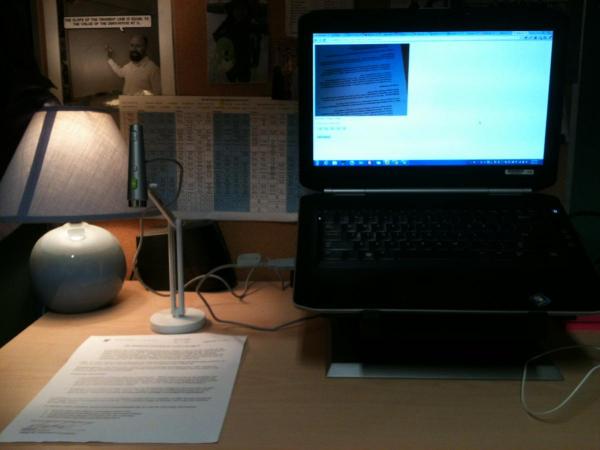
I’m working on a system where students will be able to post their non-digital work directly from a scanning station to their eportfolio blog. I want to make the system simple enough that young kids can potentially use it themselves (and ask our teachers to review the portfolios of our students periodically). To this end, instead of asking our students to enter a user name and password, I’m considering asking them to just enter a 5 or 6 digit passcode made of numbers, letters, or a word (which would be recorded somewhere for easy access for the younger students).

What I hope to avoid are collisions where two codes are so similar that students end up accidentally posting to each other’s blogs (either different by only one digit, or by two digits being transposed). One thought I’ve had is that I can use a barcode or QR code scanner, but as this may be challenging to set up, I may need to use a simple passcode to begin with.

My question is, what is the minimum passcode I can use while minimizing the chance of a passcode collision for our nearly 500 students? I’ve done some work figuring this out for myself already, but I’m curious about some other approaches.

Different multiplication strategies

I’m investigation possible models for learning multiplication. Below there are 7 possible models or algorithms. I’d like to know if you know of more models. I’ve found 12 different models for understanding/doing multiplication over at Natural Math, but have not found explanations of all of these that I can easily share.

Interestingly enough, many of these videos define multiplication at the beginning of the video with no sense that there are other possible definitions.


Binary multiplication

Line Multiplication

Lattice Multiplication

Area model

Repeated addition

Using arrays

Chip model

Connected Leadership

I’ve put together this presentation as a conversation starter for tomorrow’s Edcamp Leadership conference. What do you think the implications of these changes in our society are for educational leaders?


Internet safety

I’ve created the following presentation to use as a conversation starter with our grade 8 and 9 students. The objective is to have a discussion about the Internet and safety. I am framing the conversation with the idea that our non-digital selves co-exist with our digital selves, and that non-digital citizenship and digital citizenship are really two aspects of the same part of our personality, rather than being completely separate things.

I’d love some feedback.

(Can’t view the presentation above? See it here)


Updated:

Here is a brief explanation of how I intend to use this presentation, which will probably make it more helpful for you as an educator. Lots of ums and aahs in this description as I did it in a hurry to get it up.

Math activities for a measurement unit

Our 3rd grade students will be doing a unit on measurement soon. These are the specific standards for the measurement unit that we hope to address. I’ve been asked to brainstorm some activities for students in this unit which can be extended or modified to meet the needs of a wide range of learners.
 
BC Precribed learning outcomes in 3rd grade related to measurement
  • relate the passage of time to common activities using non-standard and standard units (minutes, hours, days, weeks, months, years)
  • relate the number of seconds to a minute, the number of minutes to an hour, and the number of days to a month in a problem-solving context
  • demonstrate an understanding of measuring length (cm, m) by- selecting and justifying referents for the units cm and m- modelling and describing the relationship between the units cm and m- estimating length using referents- measuring and recording length, width, and height
  • demonstrate an understanding of measuring mass (g, kg) by- selecting and justifying referents for the units g and kg- modelling and describing the relationship between the units g and kg- estimating mass using referents- measuring and recording mass

Here’s what I have so far:

  1. How long is a minute?

    Have students work in pairs. One student has a timer, the other student has nothing. The person with the timer says "go" and starts the timer. The other student waits (without counting or saying anything) and tries to say stop when they think a minute has gone by. Then students switch roles. Play this game once at the beginning of class, and once near the end of class (ideally just before a break), and have some of the students gather the data from the entire class and compare the numbers from the beginning of class to the times just before the break.
     

  2. What day of the week will your birthday be next year?

    Have students work together to try and figure out what day of the week their birthday will be on next year. Challenge activity: What day of the week will your irthday be on in 20 years? In 80 years? Students will choose to adopt different strategies, but you should not let them look it up on a calendar (but they are free to make their own calendar to make it easier to calculate).
     

  3. How many times will my heart beat in an hour?

    Have students measure how many times their heart beats in either 10, 15, 20, 30, or 60 seconds (or all of the above) with a partner, and then try and calculate how many times it will beat in an hour. Some students will realize that this is a multiplication problem, others will start creating lists of numbers to add together. Extension: How many times will your heart beat in a year.
     

  4. How long is a foot?

    Have students measure different things in the room with their feet as the unit of measure (to the nearest half a foot if possible – support tip: ask students, is it nearer to 2 feet or 3 feet?). Have them compare their answers to the same things they’ve measured. Talk about the need for a standard unit of measurement, which is exactly the purpose of centimetres, metres, etc…
     

  5. How heavy are things?

    Activity: Using a balance scale (which we have in the science lab in the senior school) have students measure a bunch of different things around the classroom (like pens, etc…) and compare the weights of the different things together. Now, ask the question: how many pens weight are these things? Now you can have students try and determine, using the weight of a pen as a reference, how heavy various objects are in the room.

Resources for mathematics enrichment

I’m currently putting together a list of resources for our elementary school teachers to use to enrich their mathematics classrooms. Our basic philosophy is to provide opportunities for all students to engage in rich mathematical tasks, and to add breadth & depth to their program of mathematical study, rather than accelerating through the British Columbia curriculum.

I’m looking for more resources for each of the areas below, but I don’t want to over-whelm my colleagues with options. Any suggestions? Ideally I’d like resources which are straight-forward to use, and which promote the philosophy described above.


Resources for enrichment

Problems with open-ended solutions.

Puzzles

Math contests

Games

  • Choose games which have some basis in logic & reasoning to solve, or which require students to use mathematical skills in context. Eg. Monopoly is a terrible game for logic & reasoning, but a good game to practice addition & counting in a financial context.

Programming

Real life contexts

  • Find ways the mathematics students are learning is present in their current life
  • Provide opportunities for students to learn interesting mathematics (perhaps even outside ‘the curriculum’!) that occurs in nature
  • Sample activity: Have students take photos of things which appear to be mathematical to them

Math apps

I recently realized that I have a tonne of different math mini-applications that I’ve built over the years, and I will need to take the time to catalog them at some stage (note that some of these will just not run in Internet Explorer). For now, here’s a list of the ones that might be useful, in no particular order:

Is this a necessary use of technology?

Steve Wheeler shared this video on his blog after describing constructionist learning theory. I’m not really clear on what, if anything, this robot adds to the activity of playing Snakes & Ladders. What would be different about this activity if students had to move a marker instead of pressing buttons on the robot to get it to move? Is this a necessary use of technology, or an extravagance?

I tend to lean toward the latter for this particular example. I am a supporter of technology use in schools, but we need to be thoughtful about our use of technology and given it’s expense, try and choose technologies which we can see will have an impact on student learning, rather than technologies which can be easily replaced with something far cheaper.

Can you see other ways that this particular technology could be used in a more powerful way, one which will impact student learning, and which requires this technology?

Northwest Mathematics Conference resources

I’m presenting twice at the Northwest Mathematics conference, once on computers in math, and the other on programming in math. Here are my resources from the day, which you are welcome to adapt and share (for non-commercial purposes) provided you give me attribution. Despite the titles, both of these presentations are focused on the use of computers in mathematics education, rather than the more general topic of computers in mathematics itself.


Computers in Mathematics

Programming in Math

Resources shared by participants

Lightbot 2.0 – A game which introduced programming concepts

Star Logo TNG – A 3d programming environment which uses the block system made popular in Scratch & Turtle Art.

Number line activity

Father and son playing catch
(Image credit: bterrycompton)

I co-coached my son’s blastball team last year. We spent a lot of time playing blastball, but we also spent some time practicing some of the skills needed to be able to play (while emphasizing how these skills fit into playing the game). One of the skills we practiced was throwing and catching a blastball.

How this worked is that each kid stood one or two steps away from their parent and threw the ball to their parent. If the parent caught it, the parent took a step back, and threw the ball back to their child. If their child caught it, the parent took another step back, and so on. This meant that very quickly parents and children tended to be separated by a distance where they catch the ball about half of the time. This is by itself a good activity that relates to the number line, if you think of each step apart being 1 space apart on the number line.

My son and I went through a particular fun exchange where his objective was to make sure I didn’t catch the ball, requiring me to continue closer to him. As I moved closer to him, I kept indicating where I was like so: "Okay, now I am three steps. Now I am at two steps." Eventually, I ended up zero steps away from him. To continue the joke, he managed to find a way for me not to catch the ball even though we were directly on top of each other. I continued stepping toward him, which meant that we were now facing back to back, with one step in between us. "Okay," I said, "now I am at negative one step." He had lots of questions about negative one step, and continued the game a few more times as I moved into smaller and smaller negative numbers.

While the introduction of the concept of negative numbers is obviously secondary to this activity, it is a way to tie together some fun physical activity with some conceptual understanding of the relationships between different numbers.