There are three different ways the word learning is used, and all of them are important. Educational technology companies usually pick one of these forms of learning to focus on, but to be effective, their products really need to do all three. The feedback systems built into their products need to find ways to support all three learning scenarios.
- Learning as the introduction to ideas
This is the most commonly way of understanding learning. A learner doesn’t know something and they are exposed to information that gives them new insight about the world.1 This exposure may take the form of explicit instruction or it could be as part of a guided discovery. Learning is measured by student performance on tasks completed closely related to the ideas to which a student was exposed. Improving learning is focused on either improving instructional delivery or on improving student performance on follow-up tasks.
- Learning as the activity
Sometimes learning is defined as the activity students do that results in their engagement and some measurement of performance, and this activity does not include being introduced to new information. For example, students who complete a worksheet can be said to be in the act of learning. Learning is measured by how much students participate and complete work. Improving learning centers around improving engagement with the activity.
- Learning as long-term change
Graham Nuthall, author of the Hidden Lives of Learners2, defined learning as the longterm change in what students know, believe, and can do. With this model of learning, students can be exposed to new information, complete activities, and not learn anything because the ideas didn’t stick. Learning is measured by longterm assessments measuring knowledge and skills gained over months and years. Improving learning centers around long-range strategies and finding ways for learners to remember ideas they have learned more robustly.
If one is designing a digital learning experience, all three of these ways of understanding learning need to be addressed. Ideas need to be introduced to students, students have to complete activities, and long term changes in what students know, believe, and can do should be measured.
Most educational technology solutions focus on introducing ideas to students or engaging students in activities and sometimes both. Very few products focus on ensuring students have changed in the longterm, where ironically, accountability for schools focuses nearly entirely on this aspect of learning.
Feedback while introducing ideas
When introducing ideas to students, it is an excellent practice to frequently check to see if students understand an idea. It is even better practice to check how students understand a new idea! One can then adjust instruction based on the feedback to the instructor. Ideally, this results in short cycles of introducing a small amount of information to students, engaging students in an opportunity to demonstrate their understanding, gathering evidence of that performance, and adjusting instruction.3
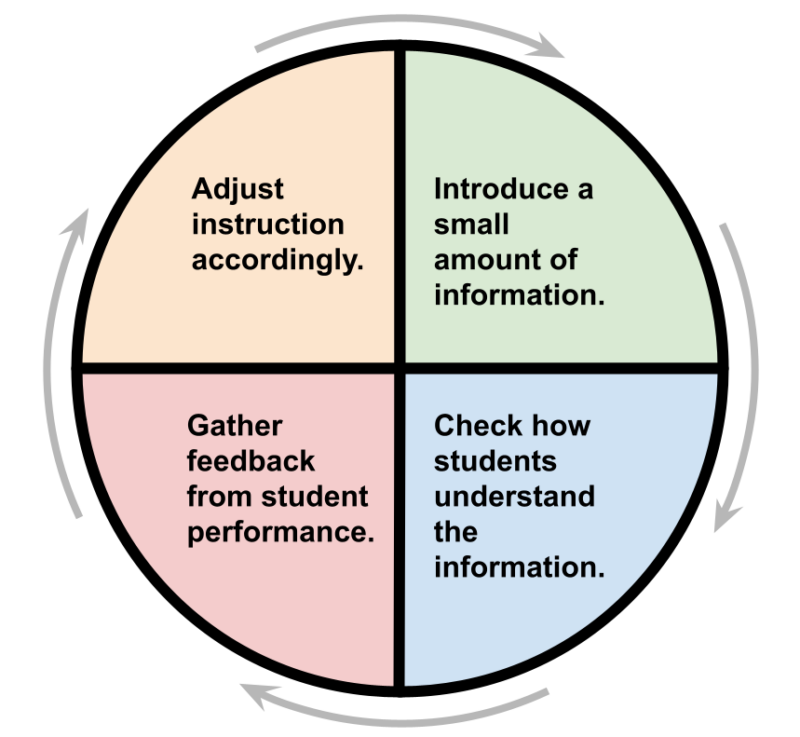
Here the feedback is mostly to the instructor and they make decisions about how to adjust their instruction that result in new information (e.g. feedback on learning) being given to learners.
Most educational technology products are not this deliberate in how they introduce information to students, and even the ones that include small incremental steps when introducing information do not consistently change their instruction as a result of a cycle like this.
Further, the information provided to instructors about student performance is generally unhelpful. Knowing that children have completed this activity or that activity (information typically provided in educational technology products) is less helpful than knowing what kinds of mistakes students were making and how to support students (information never provided in educational technology products). The lowest hanging fruit in reporting is completion data, but the closer the data is to the actual work students did, the more likely it is to be helpful. Imagine a product that takes all student work from activity and synthesizes it into the three to five most commonly used ways of thinking students had during the activity and then suggests activities instructors can do.
Feedback during activities
Key among the strategies educational technology companies have promised over the years is personalized feedback to students. Unfortunately, few products on the market deliver on this promise. If your product contains digital explanations, showing them an explanation of why they are wrong after they get an answer incorrect is the digital equivalent of reteaching by talking louder and slower. It doesn’t work. Feedback in those moments should depend on the thinking children have done, and few products include robust enough student testing in their development lifecycle to be able to create the feedback opportunities that actually work.
An alternative way of presenting feedback to students is to select a different task for them to work on. Perhaps a student is having trouble with 102 – 94 and you want them to think about this problem differently. A teacher would know that a related problem in the moment can be transformative and ask that child to try solving 100 – 94. If this is still a struggle for the child, they can try 100 – 95 first, then go back to 100 – 94, and then go back to the original problem of 102 – 94. To mitigate this struggle in the first place, one could reverse this sequence of problems, but then one might not know if the scaffolding led the child to the idea of changing 102 – 94 to 102 – 100 + 100 – 94 or if the child can do this independently. Using tasks to provide feedback is one of the more powerful instructional moves a teacher can make and most educational technology products do not even attempt to use it.
Feedback during long-term learning
Durable long-term learning is really about supporting students with revisiting ideas they to which they have already been exposed. Our brains are designed to ruthlessly trim ideas from active recall that we do not use frequently. This means, if there are things we want to remember, we either need to make the experience of learning them extremely memorable, or we need to spend effort thinking about those ideas again periodically.
No educational technology products on the market today deliberately and systematically offers students opportunities to revisit ideas over time. Every product assumes that once children have demonstrated proficiency with an idea that this proficiency is stable and unchanging. This is demonstrably false! We all know that learners forget things over time.
Spaced opportunities to revisit ideas learned is in the best interest of learners. Educational technology has the ability to track what students have demonstrated proficiency in, and to keep track of the hundreds of ideas that students should revisit and at what intervals they should come back. There is very solid evidence that spaced, interleaved repetition and practice lead to long term changes in memory.
Conclusion
There is a need for educational technology to be better than it is. More deliberate systems and focus on improving feedback in a product is one way nearly every product on the market can improve. They need to move beyond simplistic models of learning (the student completed an activity so therefore they “know it”) to models that include all three ways of understanding learning.
- This definition is problematic because it ignores the idea that students bring ideas with them when learning new things, and how they view new information is always viewed through the lens of what they know already. Children are not empty vessels to be filled!
- See this review of his book and then if you are interested in learning, find time to read this excellent book.
- This cycle can be followed regardless of whether one is using explicit instruction or guided inquiry. Either way, the amount of new information for students to process should be kept to a minimum.