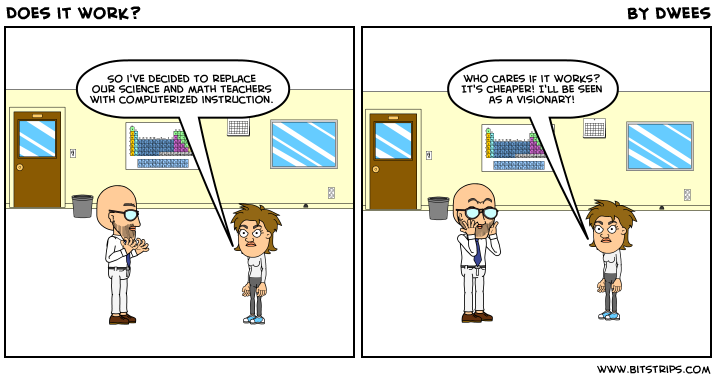
I recently learned of a massive project at Virginia Tech called the Math Emporium. Here’s a quote from the original article.
The Emporium is the Wal-Mart of higher education, a triumph in economy of scale and a glimpse at a possible future of computer-led learning. Eight thousand students a year take introductory math in a space that once housed a discount department store. Four math instructors, none of them professors, lead seven courses with enrollments of 200 to 2,000. Students walk to class through a shopping mall, past a health club and a tanning salon, as ambient Muzak plays. – Daniel de Vise
Students sit down at computer terminals and read mathematics lessons, and then take quizzes based on those lessons. The idea is compelling for those wishing to reduce the cost of higher education, because if you can successful replace people with computers to teach the classes, you don’t have to worry about benefits, salaries, and other major expenses of a university. According to the article graduation rates for the introductory courses are up, and costs are way down, as the Emporium is almost 1/3 cheaper than the previous model used at Virginia Tech.
So what do the students think? I was recently given a link to a public Facebook page where Virginia Tech staff had linked to the story.I took some screenshots of what a (probably biased) sample of the students think of the Math Emporium, just in case Virginia Tech ever decides to remove the public feedback they got on their Emporium. Here are some quotes from that page.
“How about being taught in actual classrooms… The concept that the Empo improves anything is an outright joke. It’s horrendous that I have to pay exorbitant amounts of money so I can take 30 minute bus rides to this soul-killing place and stare at a computer screen under the guise of “education.” What a load.” ~ Andrew Michael Burns
“[P]aying a lot of money to get no teacher for math. that is what i remember” ~ John Hawley
“None … it was a nightmare & I ended up having to enroll in pre calc & calc at the community college over summer because I couldn’t learn a thing online in math” ~ Amy Domianus
“I remember vividly the obnoxious, intrusive hum of the fluorescent light fixtures; the ‘tutors’ that clearly understood the problem you were asking about, but couldn’t answer your question because they barely spoke English; the feeling of overwhelming despair that seeped into my bones with every second spent glued in front of a screen; the nagging thought that my education was being reduced to an assembly-line process; the vertigo that overtook me as I glanced down the isles and beheld row upon row of workstations stretching into infinity. In my time as a college student, I never experienced anything so degrading, time-wasting, blatantly bureaucratic, and soul-less as the wretched Hell-spawned Math Emporium.” ~ Andrew Lord Wolf
There was one somewhat positive comment on the thread.
“I’m going to go against the crowd and say that I actually really like the math emporium as a place to study. I never took the classes that were solely empo based, but I did take a few that involved having to go and take quizzes. In helping people that have taken empo based classes though, I have realized that the classes aren’t so much about learning calculus as much as it is learning the tricks to the quizzes. There are only a certain number of different types of questions, and most of the questiosn have answer patterns. So basically if you do enough of them, you don’t really even need to know much calculus to be able to do well.
Study wise, I think it’s a great place to get work done. It’s bland enough that you can sit down and do work without too many distractions, and if you take your computer as well as using one of the work stations you have tons of monitor space to use, so you can look through powerpoints and take notes at the same time and such. At the same time though, if you get bored there’s always people there to talk to/take a break with.” ~ Malou Flintsch
I’ve bolded a couple of statements in this quote because they are pretty important. First, Malou never actually took any classes in the Emporium, and she is one of only two positive comments about the experience in the thread. Second, as a tutor for the Emporium, she realized that the classes weren’t about learning calculus as passing quizzes.
I interviewed someone directly who took a number of courses in the Emporium when she was an undergrad at Virginia Tech. Her name is Jessy Irwin, and she works for a technology company that offers online lessons and instructional support for mathematics. She commented that:
- There was no video explanation, just text on the screen. Often the text on the screen, and the text from her textbook used different terminology, and she would work out the solution to a problem, and then spend 20 minutes figuring which of the multiple choice responses matched her solution.
- She didn’t feel like part of a community because there was no course community. It was possible, even likely, that the people next to you in the Emporium were working on different courses, or were in a different stage in the same course.
- Everyone had to be a self-sufficient island. You could put a red cup on top of your monitor, which would tell the roaming assistants that you needed help, but she often had to wait up to 45 minutes for someone to help her, stuck on a single question that she couldn’t skip because of limitations in the software design.
- She almost hired a tutor to help her through the first year calculus course, which she ended up failing 4 times. She eventually found a math-for-liberal-arts-students course and took and passed it. Notably, no one helped her find this option after her first failure, which suggests a lack of counselling support for this program.
- She found the Emporium to be the “worst educational experience of her life.”
There are obvious problems with such a program. First, too many students hated the experience, and this is unlikely to have encouraged these students to continue learning mathematics, which is a primary purpose of mathematics courses in university! A second objective of university level mathematics is to help students continue to develop analytical and mathematical reasoning, which it seems unlikely that the Emporium is successful in doing. One does not develop analytical reasoning from guessing which multiple choice answer matches your solution, or learning the tricks to passing the course quizzes. Another purpose of university in general is to help students foster connections with other students, and begin to develop a network of peers that they will carry with them throughout their life. This purpose is not possible when students are isolated from each other so completely.
The two benefits of the Emporium are themselves contestable. Costs may be down for the university, but according to Jessy, many students have paid for private tutoring to get through the Emporium courses, or taken equivalent courses at the local community college instead. This means that some of the students, who are already paying significant tuition fees, are being forced to pay additional fees as a result of this program, which is essentially transfering the cost of instruction from the university to the student. The other benefit – the increased graduation rates – is impossible to compare to the model Virginia Tech used before the Emporium for these courses, since the courses are so different. More important than graduation rates is the amount of mathematical knowledge and reasoning skills gained by the students, for which there appears to be no data.
Unfortunately, the Emporium has spread to about 100 other colleges since it was invented, which suggests that there are hundreds of thousands of students forced to experience it. This kind of reduction of education to what can be easily measured by a computer is dangerous since we could quite possibly end up with many people believing they understand mathematical principles, when in fact they do not.
The worst part of the Emporium? Four of the courses offered in the Math Emporium are required courses for future mathematics educators. Hopefully these educators will be able to see the Emporium for what it is – a poor way to teach mathematics.




John at TestSoup says:
Wow.
This is unbelievably bad.
When I first read the description at the top, I was surprised that anyone could think this kind of model would be “good.” Apparently they do. But they must never have tried it themselves.
April 30, 2012 — 10:27 am
David Wees says:
That would be a very good practice. Before implementing any new pedagogical models, the people involved in the changes must first try the pedagogical model themselves. I’m pretty sure that the problems with this system would have been found had the people involved tried it out themselves (to learn new domain knowledge, not to reinforce their existing math knowledge).
April 30, 2012 — 11:27 am
Elise says:
Malou is female.
June 19, 2012 — 4:42 pm
David Wees says:
OOOOPS. Thanks for the correction. I basically guessed, I had a 50/50 chance (as I was not familiar with the name) and I got it wrong.
June 19, 2012 — 5:42 pm
James Montgomery says:
This is a good article. I stumbled by it looking up other colleges that have math emporium. I just finished up taking prealgebra and intermediate algebra at a local college where I am at. These emporium courses that alot of colleges are offering, feel as though they are being forced upon the student body. These courses are designed for maximum profits with minimal effort. As you stated in the article, these classes do not teach the mechanics behind the math and only show short cuts as how to solve something. I know there are many ways to solve math problems, but the main fundamental issue I see is that I myself ended up regurgitating a process I had no understanding of.
Unfortunately I did not pass my intermediate course in the emporium class. So I will be retaking algebra again at a different college. I not only feel like I wasted $1,000 on this class, but I know I wasted that and alot of my time. It is ok to learn how to complete a math problem but if you do not understand why or how you came to the answer then that is not learning at all. So if anyone else comes across this comment, do yourself a favor and skip the emporium and stick to a real professor and lecture. not only will you learn something, but it will show later on in the next semester when you still remember what you learned before.
June 14, 2013 — 9:58 pm
Abhishek says:
All the knowledge of the world is available on books and internet. We have mordern learning options like videos animations etc that helps to learn in an interactive manner but no machine instructors can ever replace a teacher. Only a teacher can teach you in different ways. Every student has different abilities machines cant understant how to teach student with different learning capabilities. For the subject like maths a good teacher is a must.
June 3, 2014 — 7:34 am