The focus of ETEC 512 is the theory behind learning. We’ve spent the past 12 weeks looking at different learning theories, and discussing how these learning theories are applicable to our students and our lives. It’s been a pretty interesting overview for me, and one I’m surprised more teachers don’t have to go through. Although I suspect many of these theories feel far removed from the daily part of a classroom, really they embody the very essence of why we teach, and what our best practices are.
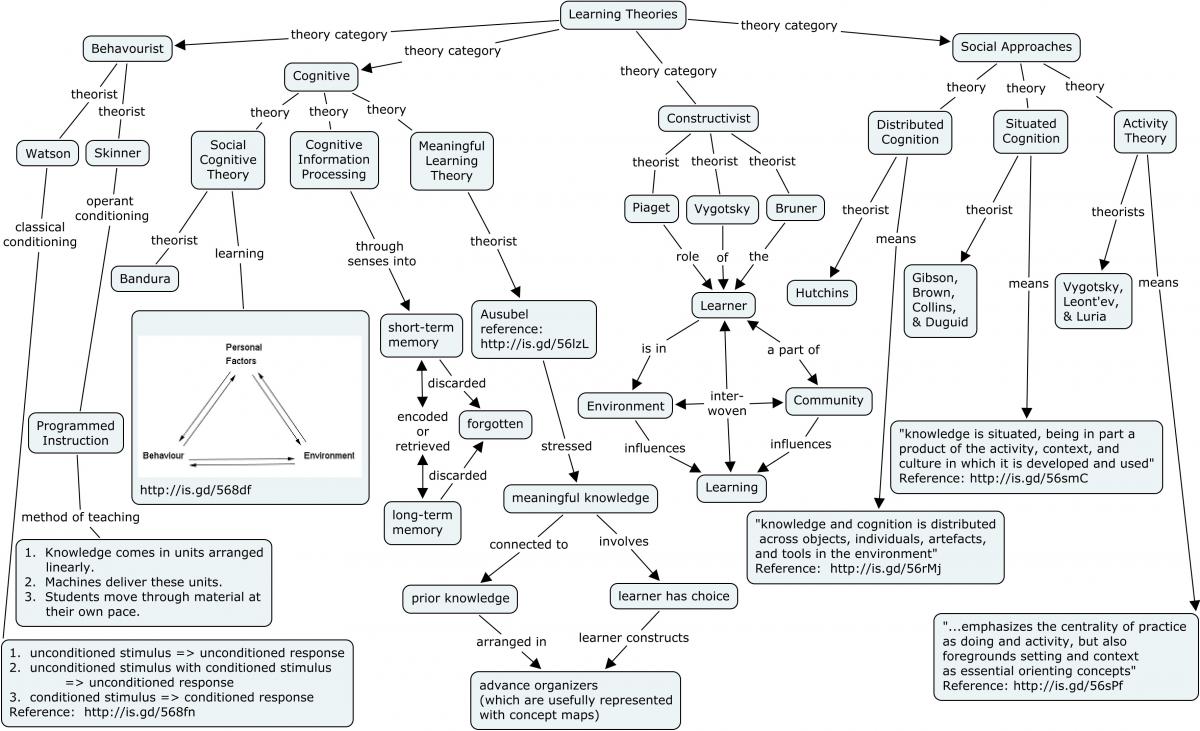
I’d like some feedback on my concept map I’ve created of these learning theories if possible. Click on the image below to see the map in full, then return here to add a comment if you can. This assignment is an important part of our final summative assessment for this course, I’d like to do it right. Feedback is always a useful way to improve one’s understanding!

Dan says:
Hi,
Just saw your post on Twitter and thought I’d take a look. I love the chart. This is always a confusing topic and I love wrestling with it.
I don’t think that I would have put Constructivist in a different category that Social Approaches. There doesn’t seem to be a clear distinction warranting a separate category. However, with that said, being in the middle of Cognitivist and Social Approaches is perfect, because it can really go both ways depending on who’s serving it up 🙂
Dan
November 29, 2009 — 3:20 am
David Wees says:
Thanks for the feedback Dan. I’ve created a connection between constructivism and social approaches to learning and another between cognitive and constructivism. My instructor had originally told me I should use constructivism as a separate category, so I’ll go with that but yes, I do see your point.
Dave
November 29, 2009 — 10:30 am
Rudi says:
Hi David,
I love the amount of work that you have done on this, but my understanding differs.
I m under the impression that the there are four main branches, Behaviorism, Constructivist, Moral & Physical. The cognitive ones are then branching off under the constructivist umbrella. I am a bit under the hammer with assignments at the moment but am happy to keep discussing.
Rudi
Mature aged student, studying to be a History/Economics teacher, at Australian Catholic University, Sydney.
April 24, 2012 — 8:56 am
David Wees says:
That could be true. This activity was, as I recall, somewhat regulated by the structure of the learning theories that my professor appreciated. I seem to recall having to redo this chart a bunch of times to "get it right."
The moral and physical branches are not included as I suspect that they can be considered domains of knowledge under behaviourism and constructivism (which as you point out should include the cognitive theories listed above, but does not in my diagram). It may be in the Catholic system that there are reasons to separate how we learn morals and about our physical selves from other domains of knowledge, but I’m not convinced this is necessary.
April 24, 2012 — 9:02 am